Introduction: The "Meta Trap" and the Crisis of Single-Channel D2C Scaling
Between 2019 and 2022, scaling a Direct-to-Consumer (D2C) brand in India appeared straightforward: set up a Shopify storefront, launch lookalike audiences on Meta Ads (Facebook & Instagram), partner with a 3PL logistics provider for Cash-on-Delivery (COD) fulfillment, and watch revenue climb. Indian consumer founders built 8-figure businesses almost entirely on the back of cheap social media traffic.
Today, that simplistic growth formula is entirely broken. The combination of Apple's App Tracking Transparency (ATT), escalating competition from corporate conglomerates entering direct selling, and ad inventory auction inflation has sent Customer Acquisition Costs (CAC) soaring across India by over 140% to 220% in key verticals such as skincare, apparel, consumer electronics, and functional food.
According to comprehensive research by Statista on the D2C Market in India, while the total addressable consumer market is projected to exceed $100 Billion, more than 80% of early-stage D2C startups plateau between ₹15 Lakh and ₹35 Lakh in monthly Gross Merchandise Value (GMV). Why? Because they remain trapped in a single-channel dependency loop. Every marginal rupee spent on Meta Ads delivers diminishing Return on Ad Spend (ROAS), while high Return-to-Origin (RTO) rates on COD orders wipe out net operating margins.
To break through the critical ₹1 Crore ($120,000+) monthly GMV threshold profitably, modern consumer brands must evolve from isolated performance advertising to a synchronized Omnichannel Growth Flywheel. As South India's leading custom digital growth, web engineering, and marketing automation consultancy, Nrootz has engineered this practical strategic playbook to help Indian D2C brands build durable, multi-touch digital ecosystems that maximize Customer Lifetime Value (LTV) and insulate unit economics.
Omnichannel Principle: Plain blog text and isolated ad campaigns cannot generate compounding search dominance or customer retention. Modern Indian consumer brands win by combining high-intent Google Search, commercial data tables, automated WhatsApp conversational funnels, and verified visual brand assets.
Single-Channel Silos vs. Integrated Omnichannel Architecture
Understanding how an integrated omnichannel ecosystem differs from traditional single-channel performance ad buying is essential for founders, CMOs, and growth operators:
| Growth Pillar | Traditional Siloed Model (Meta-Dependent) | Integrated Omnichannel Architecture |
| Traffic Acquisition | 85%+ budget dumped into Instagram & Facebook Ads | Balanced mix: Google PMax, High-Intent SEO, Meta, Quick-Commerce |
| Customer Touchpoints | Ad Click → Storefront → Abandoned Cart or Single Purchase | Unified web, WhatsApp CRM, regional marketplace storefronts, offline popups |
| Customer Data | Relying on Meta Pixel third-party modeled cookies | First-party & Zero-party data warehouse (CDP, WhatsApp verified IDs) |
| Repeat Purchase Rate | Under 12% (customers forget the brand after unboxing) | 32% to 48% via automated behavioral replenishment sequences |
| RTO Mitigation (COD) | Passive order dispatch; 28%–38% COD failure rate | AI automated WhatsApp address validation, prepay discounts (RTO <14%) |
| Target Blended ROAS | 1.4x to 2.1x (struggling to cover COGS and courier fees) | 4.2x to 6.5x Blended Marketing Efficiency Ratio (MER) |
The 5-Stage Indian D2C Omnichannel Growth Flywheel
To eliminate channel vulnerability and achieve predictable compounding scale, top-performing Indian brands execute an interconnected 5-stage growth architecture:
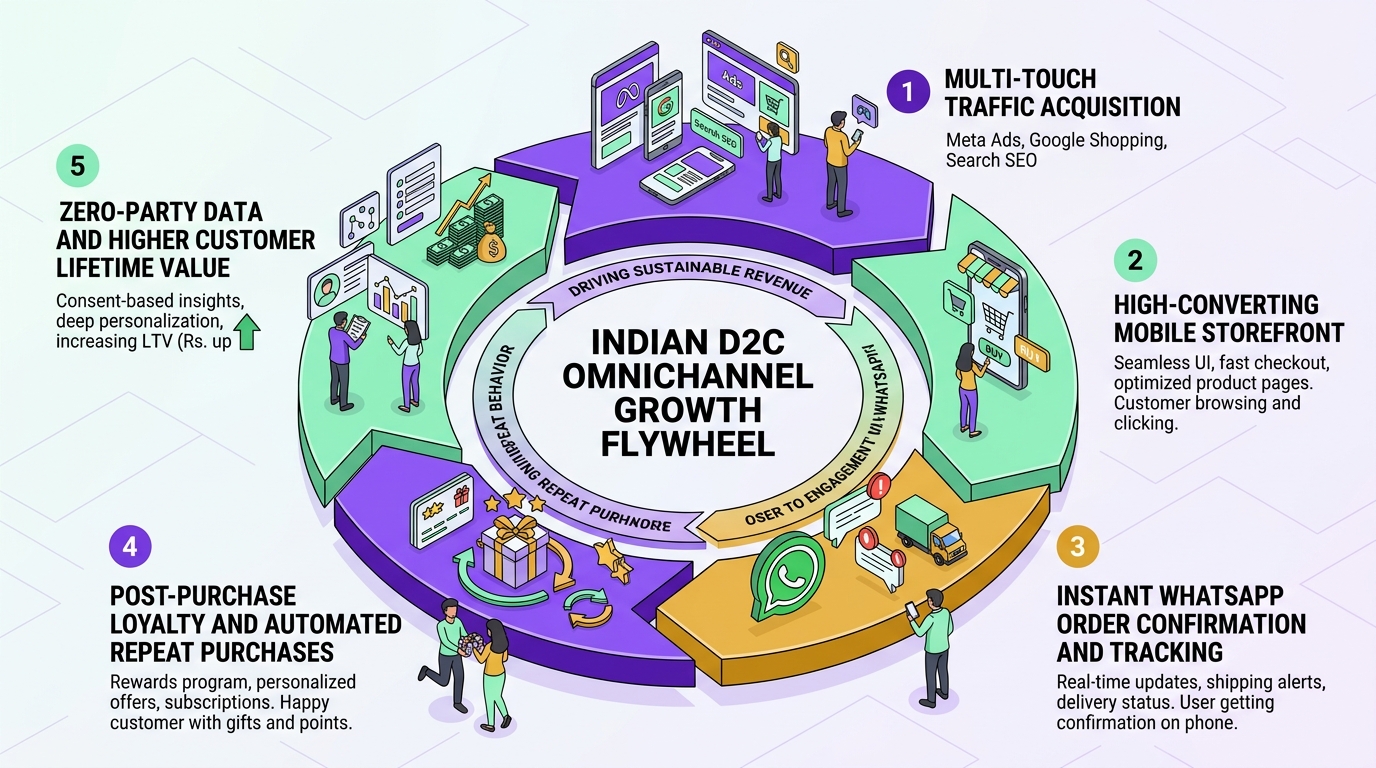
The 5 stages of the Indian D2C Omnichannel Flywheel: capturing multi-touch demand, optimizing storefront conversion, automating WhatsApp post-purchase, driving repeat purchases, and harvesting zero-party data.
1. Multi-Touch Traffic Orchestration: Capturing Intent Beyond Meta
Meta Ads excel at latent demand generation (interrupting a user while browsing their social feed), but they are disastrous when relied upon alone. An omnichannel media mix captures high-intent customers at the exact instant they are actively searching to buy:
- Google Performance Max (PMax) & Shopping Ads: While Meta introduces your brand, Google captures buyers comparing solutions. Integrating high-accuracy product feeds via Google Merchant Center captures commercial keywords like "best sulfate-free ayurvedic shampoo Kerala" or "ergonomic desk chair Bangalore".
- Intent-Driven E-Commerce SEO: Long-tail product roundups, comparison guides, and structured Product/Review schema capture top-of-funnel shoppers organically without paying for every single click.
- Regional Micro-Influencer Whitelisting: Rather than paying massive celebrity fees, collaborate with regional Kerala, Tamil Nadu, and Karnataka creators. Run their authentic video testimonials as whitelisted Dark Ads directly through their creator profiles to double CTR and authenticity.
2. High-Converting Mobile Storefront Architecture
In India, over 88% of D2C e-commerce traffic originates from mobile devices on 4G and 5G cellular connections. A sluggish, template-heavy storefront with excessive tracking scripts will cripple your funnel before prospects see your product catalog.
Insights published by Think with Google on Omnichannel Consumer Trends demonstrate that consumers seamlessly traverse multiple physical and digital research channels prior to checkout. If your mobile storefront takes longer than 2.2 seconds to load, bounce probability escalates past 45%.
- 1-Click Headless UPI Checkout: Traditional checkout forms requiring postal addresses, email passwords, and OTP verifications suffer from 65%+ cart abandonment. Deploying accelerated 1-click checkout widgets (Razorpay Magic Checkout, GoKwik, or Cashfree) pre-populates verified addresses for 80M+ Indian online shoppers and accelerates payment via Google Pay, PhonePe, and Paytm.
- Strategic COD Incentive Conversion: Cash-on-Delivery remains the default security blanket for Indian online consumers, but COD accounts for up to 90% of all return-to-origin losses. Offer dynamic 5% to 10% instant discounts for UPI prepaid conversions directly at the checkout threshold.
3. Automated WhatsApp CRM: Slashing RTO and Maximizing Retention
Email marketing in India delivers average open rates of 12% to 16%. In stark contrast, WhatsApp Business Cloud API automation commands open rates exceeding 92% and click-through rates above 35%.
When integrated deeply with your order management system and logistics partners (Shiprocket, Delhivery, Bluedart), WhatsApp becomes your primary operational and conversion engine:
- Automated COD Confirmation & Address Correction: The moment a customer places a COD order, an automated WhatsApp conversational bot triggers asking for 1-tap confirmation and precise delivery landmark verification. This single automation filters out impulsive or fake orders and reduces RTO by up to 35%.
- Pre-Delivery Out-for-Delivery (OFD) Alerts: Automated morning notifications inform the recipient of the exact courier delivery window and COD cash amount required, eliminating "Customer Not Available" delivery failures.
- Interactive Abandoned Cart Recovery: If a shopper drops off after adding a product to their bag, send a personalized WhatsApp recovery message after 45 minutes with an image of the item and an instant checkout link.
4. Automated Replenishment & LTV Maximization
First-order profitability in Indian D2C is frequently razor-thin or negative due to paid customer acquisition costs. Real commercial enterprise value is generated purely on the second, third, and fourth repeat orders where CAC is essentially zero.
As documented in the landmark Bain & Company India E-Commerce Opportunity Report, category leaders generate over 50% of annual revenue from existing customer retention. Calculate your product consumption velocity and deploy automated replenishment alerts:
- Consumable Replenishment Triggers: If a 250ml face wash lasts 35 days, trigger an automated WhatsApp replenishment prompt on Day 28 offering a 1-click re-order with saved payment details.
- Cross-Category VIP Bundling: Segment customers by purchase history. High-value repeat buyers receive early access to seasonal launches, exclusive regional gift boxes, and loyalty reward points.
5. Zero-Party Data Collection & Post-Cookie Resilience
As global privacy standards tighten and browser cookies degrade, brands that own their customer relationships hold an insurmountable competitive advantage. Zero-party data is data that a consumer intentionally and proactively shares with your brand:
- Interactive Diagnostics & Quizzes: Embed interactive skincare routines, coffee flavor selectors, or apparel fit finders on your storefront. Customers gladly answer 4–5 questions regarding their specific preferences in exchange for tailored recommendations.
- Segmented CRM Personalization: Tag customer profiles in your CRM based on quiz answers. Future marketing broadcasts can then deliver laser-targeted promotions matching exact preferences rather than generic blasts.
2026 Indian D2C Unit Economics & Multi-Channel Attribution Benchmarks
How do high-growth Indian consumer brands allocate capital across channels? Review these verified benchmark metrics compiled from Nrootz's managed consumer client portfolios:
| Channel / Metric | Ideal Budget Share (%) | Target First-Order ROAS | Strategic Function in Funnel |
| Meta Ads (Instagram/FB) | 40% – 50% | 1.8x – 2.6x | Top-of-funnel awareness, visual storytelling, impulse discovery |
| Google Shopping & PMax | 20% – 25% | 3.2x – 4.8x | High-intent commercial capture, product comparison shoppers |
| Organic Search & E-com SEO | 10% – 15% (Investment) | Inf. (Zero marginal CPC) | Durable non-paid baseline traffic, informational authority |
| WhatsApp Automation CRM | 5% – 8% | 8.0x – 15.0x | Cart recovery, COD verification, repeat replenishment, loyalty |
| Micro-Influencer Whitelisting | 8% – 12% | 2.4x – 3.5x | Regional social proof, localized vernacular engagement |
Why D2C Brands in Kerala and Across India Partner with Nrootz
Transitioning from a chaotic, ad-dependent e-commerce shop to an enterprise-grade omnichannel engine requires specialized full-stack capabilities. Most digital marketing agencies operate as superficial media buyers who possess zero understanding of backend database architecture, custom web performance, or automated API pipelines.
At Nrootz, we unite cutting-edge custom web design, high-converting checkout UX, performance media buying, and enterprise CRM automation under a unified growth strategy. Whether you are launching a bespoke direct-to-consumer lifestyle brand from Kochi or scaling a national FMCG startup across tier-1, tier-2, and tier-3 Indian cities, our engineering and growth teams deliver the technical infrastructure and attribution models needed to scale profitably.
Frequently Asked Questions (FAQ)
What is the minimum monthly ad budget required to execute an omnichannel D2C strategy?
While early experimentation can begin at ₹75,000 to ₹1 Lakh per month, a robust multi-channel strategy (balancing Meta discovery, Google Shopping, and automated WhatsApp CRM) typically hits full statistical velocity at ₹2 Lakh to ₹5 Lakh in monthly ad spend. At this tier, algorithmic learning models on both Meta and Google gather sufficient conversion data to optimize bidding accurately.
How does an omnichannel strategy directly reduce Cash-on-Delivery (COD) RTO rates?
Omnichannel systems tackle RTO through automated multi-touch validation: immediately upon order placement, an automated WhatsApp bot verifies the recipient's identity, confirms willingness to accept delivery, and corrects inaccurate pin codes or landmarks. Furthermore, by offering instant UPI discounts and dynamic payment links prior to delivery, up to 25% of COD customers convert to prepaid before the courier arrives.
Why is Google Performance Max (PMax) critical for D2C brands already running Meta Ads?
Meta Ads excel at demand discovery, but prospects rarely purchase on their very first social media impression. Many users immediately open Google to search for the brand name, product reviews, or price comparisons. If your brand does not dominate Google Search and Shopping via PMax, competitor brands and retail aggregators will bid on your keywords and steal your high-intent traffic.
How does custom web design outperform standard Shopify themes for D2C growth?
Standard Shopify themes come burdened with bloated JavaScript, redundant theme settings, and rigid layout constraints that slow down mobile page load times. Custom-coded, performance-optimized storefronts engineered by Nrootz achieve sub-1.5 second loading speeds on 4G networks, feature bespoke 1-click checkout architectures, and elevate mobile conversion rates by 40% to 75%.
What is the single most important metric for evaluating omnichannel success?
The primary North Star metric is the Blended Marketing Efficiency Ratio (MER), calculated as Total Net Revenue divided by Total Ad Spend across all paid channels. Relying solely on platform-reported ROAS is misleading due to attribution overlap and double-counting between Meta and Google. A healthy scaling D2C brand in India targets a blended MER of 4.0x or higher.