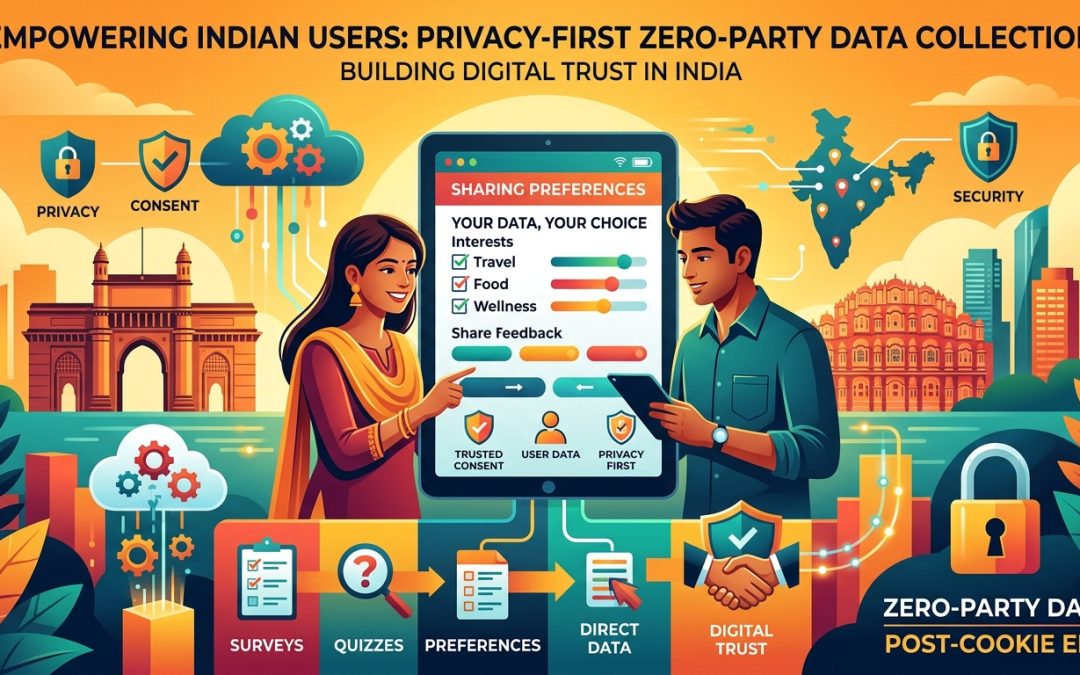
Introduction: The Death of Covert Tracking and India's Privacy Revolution
For more than a decade, the growth engine of digital business across India relied on an unspoken, invisible bargain. Brands, ad agencies, and e-commerce platforms deployed third-party tracking pixels, cross-domain cookies, and opaque data exchanges to shadow consumers across the web. This surveillance-driven advertising model allowed growth marketers to build hyper-targeted Facebook lookalike audiences, retarget shoppers with abandoned cart banners across independent websites, and attribute sales with algorithmic ease.
Today, that fragile tracking ecosystem is permanently collapsing. The seismic combination of Apple’s App Tracking Transparency (ATT), major browsers systematically deprecating third-party cookies, and increasing consumer resistance to invasive digital surveillance has rendered legacy tracking mechanisms obsolete. Across India, brands relying strictly on conventional paid advertising are reporting catastrophic spikes in Customer Acquisition Costs (CAC), with cost-per-click (CPC) and cost-per-lead (CPL) benchmarks surging by 120% to 200% across competitive verticals such as fintech, healthcare, consumer goods, and real estate.
Compounding this technical upheaval is a decisive legal watershed: the enactment of India's Digital Personal Data Protection (DPDP) Act. The DPDP Act sweeps away the Wild West era of unconsented data harvesting, imposing severe statutory penalties—reaching up to ₹250 Crore per violation—for entities that collect, store, or process consumer personal information without explicit, unambiguous, and verifiable consent. Businesses that fail to transition from covert surveillance to transparent, consent-first data architecture face not only commercial decline, but catastrophic regulatory liability.
In this privacy-first reality, winning businesses must pivot to the most valuable asset in modern digital commerce: Zero-Party Data. As Kerala's premier custom web engineering, digital branding, and automated CRM growth consultancy, Nrootz details how Indian enterprises can architect, collect, and activate zero-party data to forge unbreakable customer relationships and insulate their unit economics from ad platform volatility.
Privacy Architecture Truth: In the post-cookie digital economy, customer data cannot be harvested through stealth tracking. Sustainable enterprise valuation belongs to brands that earn direct, voluntary preference disclosures through transparent value exchanges and high-trust digital experiences.
The Customer Data Hierarchy: Zero, First, Second, and Third-Party Data
To construct an effective post-cookie growth engine, founders, CMOs, and technical architects must clearly delineate the four distinct classifications of customer data:
| Data Tier | Core Definition | Acquisition Mechanism | Accuracy & Trust | DPDP Act Risk |
| Zero-Party Data | Data intentionally, proactively, and explicitly shared by the customer in a transparent value exchange | Interactive quizzes, preference centers, conversational chatbots, post-purchase surveys | Absolute (100% verified intent directly from customer) | Zero Risk (Explicit, affirmative consent by design) |
| First-Party Data | Data inferred and collected from user behavior and events across your owned properties | Website analytics (GA4), order histories, scroll depth, session heatmaps | High accuracy on actions, but reveals nothing about the "why" or context | Low Risk (Requires clear privacy policy & cookie banners) |
| Second-Party Data | Another trusted brand’s first-party data acquired through a direct partnership agreement | Co-marketing campaigns, data clean rooms, strategic partner integrations | Moderate accuracy; heavily reliant on partner data hygiene | Moderate Risk (Requires explicit cross-sharing data agreements) |
| Third-Party Data | Aggregated data bought from external data brokers with zero direct relationship to the consumer | Cookie aggregators, ad network graphs, scraped public phone registries | Very Low (Stale, inaccurate, prone to bot traffic and spoofing) | Severe Liability (Direct violation of modern DPDP consent mandates) |
4 High-Converting Strategies for Zero-Party Data Collection in India
Consumers will never volunteer their personal contexts, budgetary constraints, or lifestyle preferences without an equitable value exchange. You must incentivize disclosure through engaging, interactive digital touchpoints:
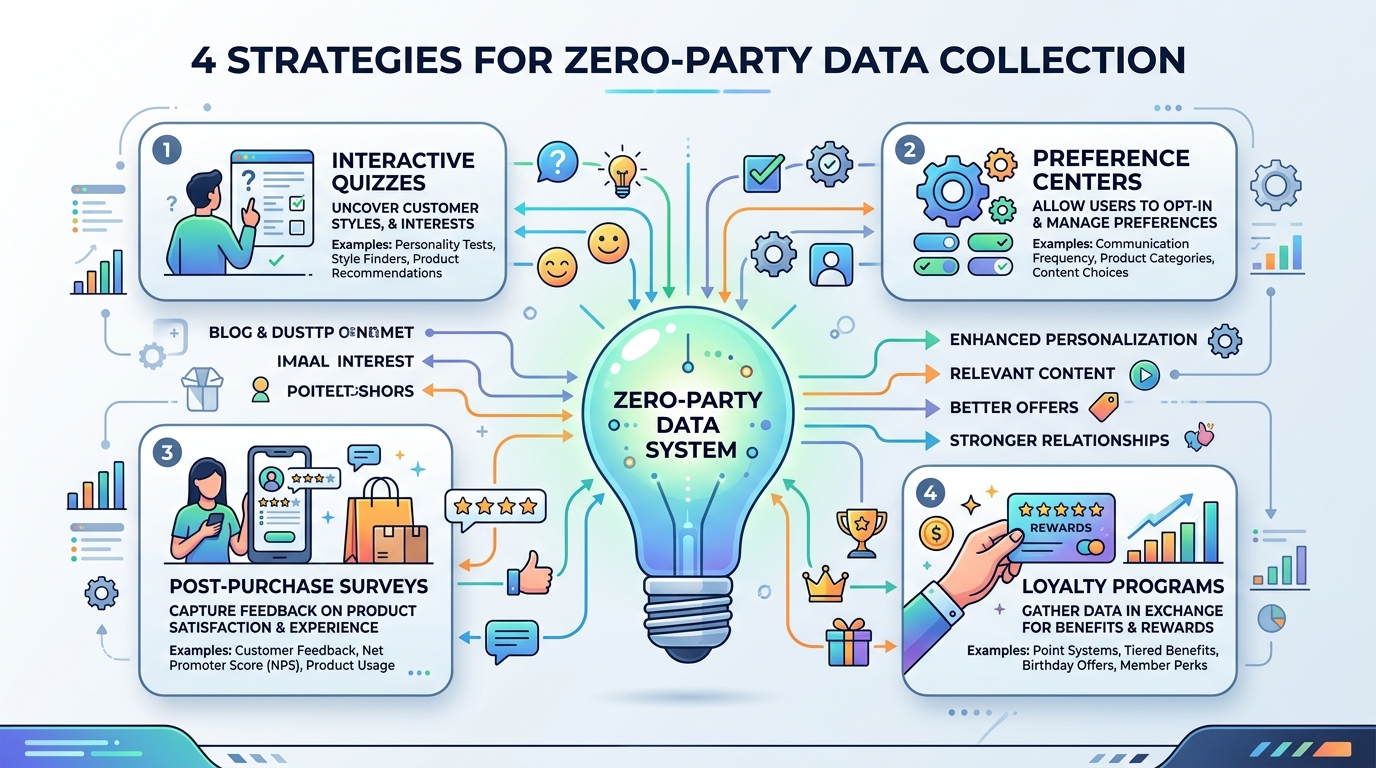
The 4 Strategic Pillars of Zero-Party Data Capture: Interactive Quizzes, Preference Centers, Conversational WhatsApp Automation, and Post-Purchase Loyalty Programs.
1. Gamified Diagnostic Quizzes & Guided Product Finders
Diagnostic quizzes represent the single highest-converting zero-party data mechanism in modern e-commerce. Instead of forcing visitors to navigate an overwhelming catalog of 400 product SKUs, invite them to take an interactive, 60-second diagnostic assessment.
For instance, an Indian direct-to-consumer Ayurvedic or skincare brand can implement a "Skin Dosha & Environmental Damage Assessment." By answering 5 rapid, non-invasive questions regarding skin sensitivity, daily sun exposure, dietary routines, and primary skin goals, the visitor receives an instant, tailor-made daily regimen. In that single 60-second session, the brand acquires verified, unalterable zero-party data regarding the customer's exact concerns, skin type, and purchasing timeline—without deploying a single tracking cookie.
2. Granular Preference Centers & Account Onboarding
Standard account creation forms in India are notoriously generic: they demand a name, phone number, and password, immediately followed by daily promotional blasts that lead to swift unsubscriptions or WhatsApp blocks. A modern preference center turns account creation into an empowering brand ritual.
Give customers explicit autonomy over their digital journey:
- Topic & Category Affinity: Allow users to specify exactly what content or products they care about (e.g., "Notify me only about B2B SaaS case studies and enterprise SEO updates, exclude general marketing news").
- Channel Cadence Selection: Let users declare their preferred communications medium—such as weekly email digests, SMS order confirmations, or instant WhatsApp dispatch alerts.
- Family & Household Context: In lifestyle, grocery, and apparel sectors, invite users to share pet ownership, children's age brackets, or anniversary dates in exchange for personalized annual gift vouchers.
3. Conversational Marketing via WhatsApp Business Cloud API
In India, digital interaction does not happen in email inboxes; it lives on WhatsApp. With more than 500 million active users across the country, WhatsApp represents the ultimate conversational channel for zero-party data capture.
By integrating conversational AI agents powered by the official WhatsApp Business Cloud API into your CRM, brands can engage prospects in organic, empathetic two-way dialogues:
- When a user scans a QR code at an offline retail store or clicks an ad, the WhatsApp assistant prompts: "Welcome! Are you looking for formal office footwear or casual weekend sneakers today?"
- Based on the reply, the bot routes the user into specific catalog options while simultaneously writing the preference tag directly into the customer's CRM profile.
- This conversational approach feels helpful rather than intrusive, yielding response completion rates exceeding 65% to 80%, compared to under 10% for traditional web forms.
4. Post-Purchase Surveys & Tiered Loyalty Rewards
The golden psychological window for customer engagement occurs in the 5 minutes immediately following a confirmed transaction. The dopamine of purchase is high, trust is validated, and the buyer is receptive to dialogue.
Deploy a friction-free, one-click post-purchase survey directly on the order confirmation screen or via automated WhatsApp message:
- Attribution Validation: "How did you first discover us?" (Direct zero-party feedback unmasks dark social sharing, word-of-mouth recommendations, and podcast mentions that ad analytics tools fail to track).
- Usage Context: "Is this purchase for yourself, or a gift for an upcoming occasion?"
- Loyalty Gamification: Offer immediate reward points, cashback tokens, or free shipping on future orders when users complete their comprehensive lifestyle profile in your loyalty portal.
Activating Zero-Party Data Across Your Omnichannel Tech Stack
Collecting zero-party data without operationalizing it is an expensive vanity exercise. The true commercial multiplier occurs when this verified preference data is centralized within an enterprise Customer Data Platform (CDP) or unified CRM (such as Zoho, HubSpot, or Salesforce) and activated across every marketing channel:
- Hyper-Personalized Automated Email & WhatsApp Flows: Eliminate spray-and-pray newsletter blasts. Trigger tailored lifecycle journeys based on explicitly stated timelines. If a customer stated during an onboarding quiz that they plan to renovate their home in October, initiate automated design inspiration and pricing catalogues in mid-September.
- High-Efficiency First-Party Lookalike Modeling: While third-party cookie targeting is dying, major advertising platforms (Meta Ads, Google Ads) still allow encrypted First-Party Customer Match uploads. By uploading segments of customers who declared high purchasing budgets and specific category affinities, you feed advertising algorithms with the highest-quality seed data available, dramatically improving lookalike targeting efficiency.
- Dynamic Storefront Personalization: Hand-coded headless storefronts can ingest customer tags from the CRM session to dynamically modify the homepage hero banner, featured category cards, and navigation order based on the user's previously declared preferences upon return.
DPDP Act Compliance: The Legal Imperative for Indian Enterprises
Adhering to authoritative global data privacy principles, such as the General Data Protection Regulation (GDPR) standards and India's landmark Digital Personal Data Protection Act, requires engineering trust directly into your technical architecture:
- Explicit Purpose Limitation: Under the DPDP Act, personal data collected for one stated purpose (e.g., providing a size recommendation) cannot be secretly repurposed for unrelated promotional campaigns without fresh consent.
- Right to Withdraw & Erasure: Provide straightforward, automated digital mechanisms allowing users to review their stored profile preferences, modify consent toggles, or request complete account deletion within 48 hours.
- Data Minimization: Collect only data points that have a direct, actionable commercial utility. Never demand extraneous personal details that introduce unnecessary friction and trigger user skepticism.
Why Partner with Nrootz for Zero-Party Data & CRM Architecture
At Nrootz, we recognize that true digital dominance in the post-cookie era requires an intersection of deep software engineering, customer behavioral psychology, and enterprise CRM automation. Standard marketing agencies focus exclusively on burning ad budgets on Meta and Google, leaving clients vulnerable to inevitable tracking decay and platform policy changes.
From developing custom-coded, ultra-fast diagnostic web applications and interactive preference centers to architecting unified WhatsApp Business API CRM automations and DPDP-compliant data governance systems, our engineering and growth teams help Indian startups and national enterprises build sovereign, highly profitable first-party customer ecosystems.
Frequently Asked Questions (FAQ)
How does zero-party data differ from first-party behavioral data?
First-party data is observational and behavioral; it tracks what a user did (e.g., visited 3 product pages, added an item to cart, spent 4 minutes on a blog). Zero-party data is explicit and intentional; it reveals why they did it, what their future intentions are, and what their personal constraints or preferences look like (e.g., they explicitly stated their budget is ₹3,000 and they have sensitive skin).
How does zero-party data help lower Customer Acquisition Costs (CAC) on Meta and Google Ads?
Zero-party data lowers CAC in two ways: first, by drastically improving customer retention and repeat purchase rates through personalized lifecycle email and WhatsApp flows, which boosts Customer Lifetime Value (LTV); second, by enabling brands to upload highly segmented lists of high-intent buyers into Google Customer Match and Meta Custom Audiences to generate superior Lookalike Audiences without relying on degraded third-party tracking pixels.
What are the penalties for non-compliance under India's DPDP Act?
The Digital Personal Data Protection Act introduces severe financial penalties for data fiduciaries that fail to implement reasonable security safeguards or violate consent and purpose limitation mandates. Fines can reach up to ₹250 Crore per infraction, making privacy-first data architectures an imperative operational priority for every Indian business.
Will implementing quizzes and preference centers create friction and decrease website conversion rates?
When designed poorly as tedious surveys, forms introduce friction. However, when engineered as gamified, visually polished diagnostic tools that provide immediate tangible value (such as personalized skin routines, product calculators, or instant discounts), conversion rates routinely increase by 30% to 50% because they eliminate choice paralysis for the customer.
What software stack is recommended for capturing and managing zero-party data in India?
An effective enterprise zero-party data stack typically includes a high-performance custom frontend (Next.js or React) for dynamic quizzes, integrated with a conversational WhatsApp Business API platform (such as Aisensy or Wati), connected directly into an enterprise CRM or Customer Data Platform (such as Zoho CRM, HubSpot, or Klaviyo) for centralized customer profiling and automated segmentation.