
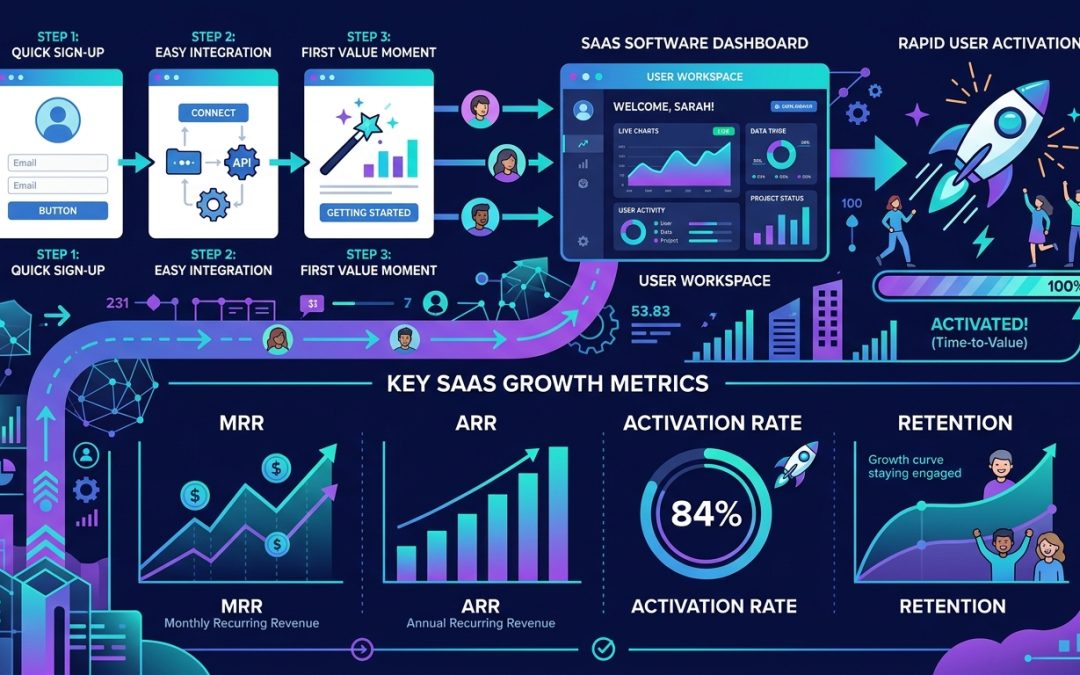
Introduction: The Breakdown of the Traditional Sales-Gated Funnel
For more than a decade, enterprise and B2B software distribution operated on a predictable, sales-heavy model. SaaS companies invested heavily in outbound sales development teams, locked software access behind "Request a Demo" contact forms, and required prospective buyers to complete multi-step qualification calls before ever seeing an active product dashboard.
Today, that traditional Sales-Led Growth (SLG) model is facing severe friction. Modern software evaluators—ranging from software engineers and product designers to department heads and operational executives—demand immediate product autonomy. Groundbreaking enterprise software research published by OpenView Venture Partners on Product-Led Growth reveals that more than 75% of B2B software buyers strongly prefer to evaluate software directly through self-serve trials rather than navigate a scheduled sales presentation.
When an application forces prospective users to fill out lengthy intake questionnaires and wait days for a representative to contact them, high-intent traffic leaks directly to agile competitors. High-performing modern software companies—exemplified by platforms like Figma, Canva, Slack, and Datadog—expand on the principles of Product-Led Growth (PLG).
Under a PLG model, the software itself acts as the primary engine driving customer acquisition, initial activation, continuous retention, and monetization. However, succeeding with PLG requires far more than adding a signup button; it demands obsessive focus on self-serve onboarding UX design, cognitive friction reduction, and radical Time-to-Value (TTV) optimization. As a leading bespoke web engineering, product design psychology, and conversion optimization agency, Nrootz details how SaaS organizations can architect onboarding flows that convert free evaluators into committed, paying customers.
PLG Experience Principle: If a user must review technical manuals or schedule a demonstration to understand your product's core utility, your architecture is not product-led. Effective PLG turns initial product discovery into an intuitive, guided experience that delivers measurable value within the first 300 seconds.
Sales-Led Growth (SLG) vs. Product-Led Growth (PLG): Strategic Comparison
Examine how legacy sales-led software distribution contrasts with a modern, self-serve product-led framework:
| Key Metric | Sales-Led Growth (SLG) | Product-Led Growth (PLG) |
| Initial Conversion Hook | Gated demo form, discovery call, qualification meeting | Immediate self-serve trial or freemium workspace |
| Time-to-Value (TTV) | Days or weeks (Dependent on scheduling and manual setup) | Under 5 minutes (Pre-loaded data and targeted setup paths) |
| Customer Acquisition Cost (CAC) | Substantial (High sales compensation and prolonged cycles) | Significantly lower (Product handles initial qualification) |
| Primary Target Persona | Top-down corporate buyer (VP, Executive Director) | Bottom-up end-user practitioner (Team lead, Specialist) |
| Expansion Mechanics | Manual contract renegotiation and upsell meetings | Natural usage milestones, team invites, tiered self-serve paywalls |
| Distribution Scalability | Limited by sales team capacity and timezone boundaries | Continuous, automated adoption across timezones |
The 5-Stage PLG User Onboarding Flywheel
A high-converting self-serve onboarding engine is not a passive checklist; it is an orchestrated psychological path designed to transition casual visitors into regular, high-value users. The flywheel operates across five interdependent phases:
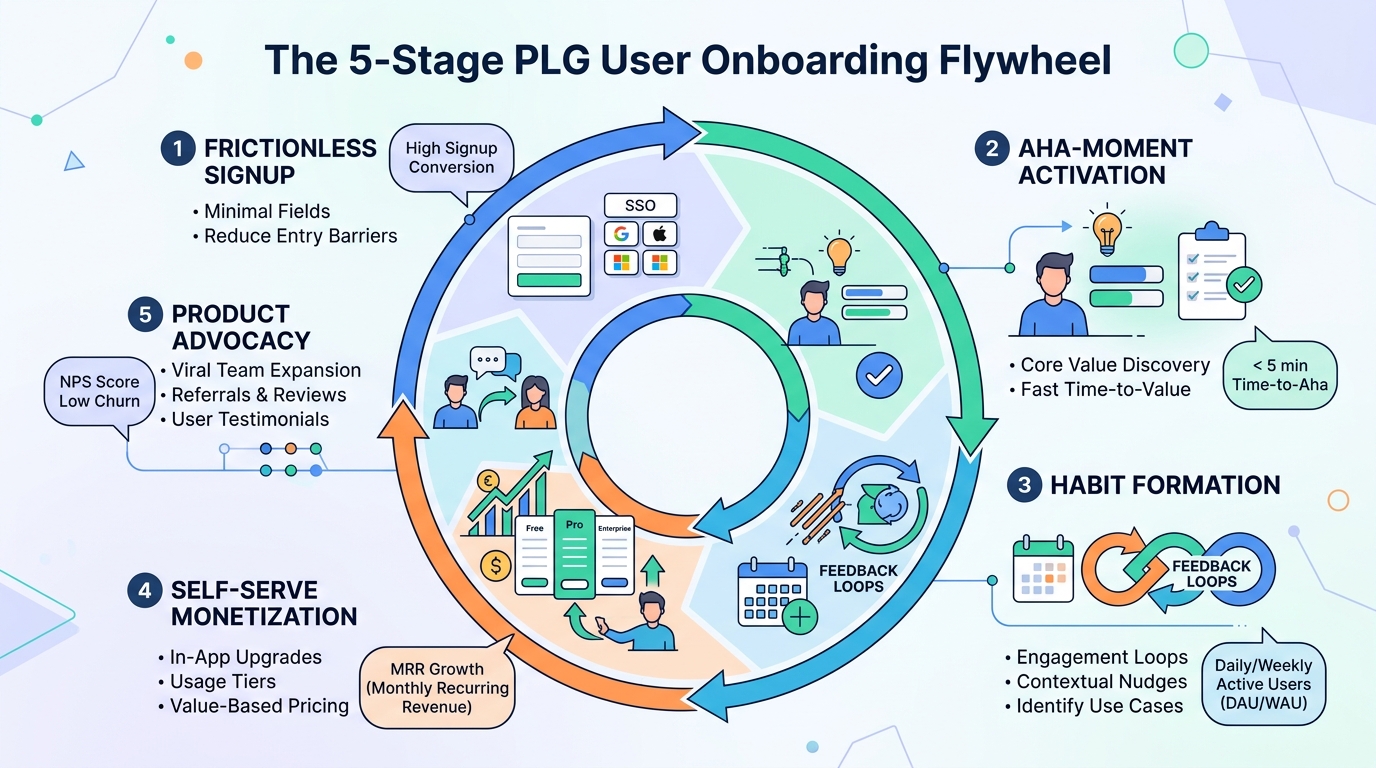
The 5-Stage PLG User Onboarding Flywheel: Systematically guiding users through Frictionless Signup, Aha-Moment Activation, Habit Formation, Self-Serve Monetization, and Product Advocacy.
1. Frictionless Signup: Eliminating Unnecessary Barriers
The first 30 seconds of an onboarding flow determine whether an evaluator engages with the software or permanently leaves the page. Signup screens represent one of the highest drop-off risks in digital product funnels.
Usability research codified by the Nielsen Norman Group on Form Usability confirms that each supplementary field introduces cognitive drag and drops conversion rates. To maximize signup completion:
- Single-Click Authentication: Integrate social and enterprise identity providers (Google Workspace, Microsoft, GitHub). Over 60% of modern B2B evaluators utilize single-sign-on (SSO) to avoid manual password management.
- Deferred Credit Card Collection: Requiring billing details prior to product access reduces top-of-funnel exploration by up to 70%. Reserve financial data requests until the user experiences clear value and actively chooses to upgrade.
- Progressive Profiling: Avoid asking for company size, revenue numbers, and phone extensions upfront. Request only the user's name and work email; gather additional operational context naturally as advanced features are configured.
2. The "Aha! Moment" & Time-to-Value (TTV) Compression
The "Aha! Moment" is the pivotal milestone where a user first experiences the tangible core benefit of a product. In design tools, it is completing an initial graphic in seconds; in communication tools, it is sending an instant message to a team member without setup hurdles.
Many SaaS applications drop new users onto a blank canvas with no direction—a common UX pitfall known as the "Empty State Trap." To accelerate initial Time-to-Value:
- Populated Starter Environments: Never present a completely empty dashboard. Provide realistic sample projects, mock analytics, or editable templates so new users instantly understand how the platform operates in full production.
- Goal-Oriented Onboarding Branches: Present an introductory 1-question selector: "What do you want to accomplish first?" (e.g., "Analyze customer churn," "Automate invoices," or "Connect an API"). Route the user directly into that workflow, bypassing unrelated settings.
- Interactive Checklists with Momentum: Implement a clean progress checklist with 3 to 4 achievable actions. Leveraging the psychological Zeigarnik Effect (the cognitive drive to complete unfinished tasks), start the checklist with the initial step pre-completed (e.g., "✓ Workspace Created") to establish momentum.
3. Habit Formation & Triggered In-App Feedback Loops
Initial activation does not guarantee ongoing adoption. To transform occasional evaluators into habitual active users, interfaces must introduce structured behavioral reinforcement loops:
- Contextual Micro-Celebrations: When a user finishes their first integration, publishes a document, or achieves a milestone, acknowledge progress with subtle, pleasant micro-interactions (such as an unobtrusive success badge or confirmation animation).
- Action-Triggered Lifecycle Communications: Send automated emails based on actual user activity rather than fixed schedules. If a user creates a project but has not invited teammates after 48 hours, send a concise tutorial illustrating collaborative advantages.
- Targeted Hotspots over Rigid Screen Takeovers: Avoid forced 10-step modal tours that block the entire screen and require clicking "Next" repeatedly. Replace them with subtle, pulsing tooltips that appear only when a user interacts with a feature for the first time.
4. Self-Serve Monetization & In-App Upgrade Paths
In product-led models, customers upgrade not because a sales representative pressured them, but because their natural product usage exceeded initial tier parameters.
Effective self-serve paywalls align commercial incentives with user success:
- Value Metric Alignment: Tie billing directly to the metric that represents user value (active team seats, processed records, API transactions, or storage usage). The pricing structure should expand alongside the customer's operational success.
- Frictionless In-App Upgrade Modals: When users explore premium capabilities (such as single sign-on, advanced audits, or automated exports), avoid generic error notices. Display an informative modal explaining the benefits with an option for an immediate trial.
- Transparent Tier Comparisons: Provide clear, uncluttered pricing matrices with self-serve checkout, flexible billing cadences, and immediate account provisioning.
5. Built-in Virality & Product-Led Expansion Loops
The defining advantage of Product-Led Growth is the self-sustaining viral expansion loop. When a product’s natural daily workflow involves interacting with external collaborators, current users become primary acquisition channels:
- Collaborative Invites as Core Workflows: Design workflows that naturally involve external stakeholders (e.g., sharing a design link, sending an invoice, or requesting a digital signoff). Every shared link acts as a qualified introduction to the software.
- Discreet Brand Attribution: On free or starter tiers with external-facing assets (such as published forms, survey screens, or support portals), include an understated badge linking directly back to the signup flow.
Evaluating Monetization Packaging: Freemium, Free Trial, and Reverse Trial
Selecting the appropriate monetization structure requires balancing customer acquisition velocity with conversion efficiency:
| Monetization Model | Operational Mechanism | Optimal Product Category | Typical Conversion Rate |
| Freemium | Core features remain free indefinitely; premium tiers gate higher volume and advanced tools | Products with low marginal infrastructure costs and inherent collaborative mechanics | 2% – 5% free-to-paid conversion |
| Time-Limited Free Trial | Full functionality provided for 14 or 30 days; access terminates without payment | Specialized B2B utilities with clear commercial ROI and rapid evaluation requirements | 8% – 15% trial-to-paid conversion |
| The Reverse Trial | Users start on enterprise tier for 14 days; without upgrading, they drop back to free tier | SaaS applications combining organic bottom-up adoption with advanced enterprise features | 12% – 20% blended conversion |
Why Partner with Nrootz for PLG Web Design & SaaS UX Transformation
At Nrootz, we recognize that building a category-leading software company requires an integration of modern frontend engineering, behavioral interface psychology, and conversion rate optimization.
From developing high-speed marketing storefronts to engineering frictionless self-serve onboarding dashboards, interactive sandbox environments, and data-driven upgrade paths, our teams partner with innovative software companies to turn product interfaces into compounding growth engines. We help software organizations optimize user activation, compress Time-to-Value, and build scalable self-serve funnels.
Frequently Asked Questions (FAQ)
What is the most critical metric for evaluating a PLG onboarding flow?
While signup volume provides top-of-funnel insight, the primary North Star metric of PLG onboarding is the Product Activation Rate—the percentage of newly registered users who complete the core action delivering their initial "Aha! Moment" within their first 24 to 48 hours. Organizations maintaining activation rates above 40% typically achieve compounding net revenue retention.
Can complex enterprise B2B products successfully deploy Product-Led Growth?
Yes, via a hybrid methodology known as "Product-Led Sales" (PLS). Complex enterprise products use self-serve onboarding to allow individual practitioners (such as software engineers, designers, or data analysts) to adopt the platform friction-free. Once multiple employees within an organization are active, internal telemetry flags a "Product Qualified Lead" (PQL), enabling enterprise sales teams to reach executive leadership backed by real internal adoption data.
How does Time-to-Value (TTV) directly influence user churn?
Modern users expect rapid clarity. If an evaluator cannot complete a meaningful outcome within their initial 5-minute session, cognitive fatigue sets in and the product is abandoned. Usability data indicates that users who experience a positive outcome during their first session are significantly more likely to remain active and renew at the 90-day mark compared to those who experience complex setup delays.
What distinguishes Marketing Qualified Leads (MQLs) from Product Qualified Leads (PQLs)?
An MQL is a prospect who engaged with external marketing content (such as downloading a whitepaper, registering for an event, or visiting a pricing page). Conversely, a PQL is an active software user who experienced verified product value by hitting meaningful in-app usage thresholds (such as inviting team members, generating production reports, or approaching usage limits). PQLs routinely convert at substantially higher rates than traditional MQLs.
What are the key technical components of an effective self-serve checkout?
A modern self-serve checkout requires minimal fields, multi-currency support, clear automated billing cycles, and immediate account provisioning upon successful payment. Reducing checkout steps and offering flexible billing frequencies removes final barriers to enterprise card upgrades.