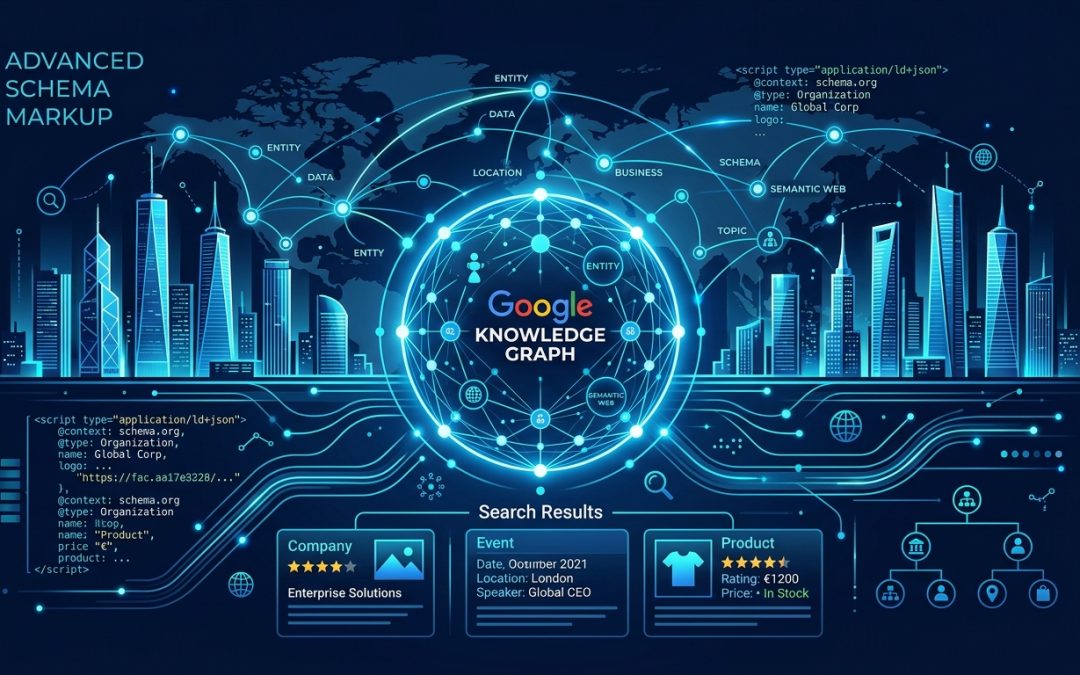
Introduction: The Paradigm Shift from "Strings to Things"
For decades, search engine optimization operated on an elementary, string-based matching premise: discover high-volume search phrases, place those exact words in title tags and headings, build external hyperlinks, and rely on crawlers to rank the page. While this lexical approach powered early search indexing, it has become fundamentally inadequate in an era defined by artificial intelligence, neural embeddings, and vector search systems.
Modern search engines do not interpret websites as disconnected text files; they understand them as interconnected real-world entities. As Google famously stated when introducing the Knowledge Graph, the fundamental objective of modern search is organizing information around "Strings to Things." An entity—whether an enterprise corporation, a software application, an industry executive, or a patented methodology—is a distinct, uniquely identifiable concept defined by verifiable attributes and established relationships within authoritative knowledge bases.
As enterprises scale, relying solely on keyword placement leaves their digital presence vulnerable to algorithmic volatility and invisible to generative search engines like Google AI Overviews, SearchGPT, and Perplexity. When search algorithms cannot determine precisely who an organization is, what specific expertise it commands, and how its products relate to recognized industry taxonomies, organic visibility quickly deteriorates.
The solution is Advanced Schema Markup and Knowledge Graph SEO. By engineering structured linked data with JSON-LD, enforcing rigorous entity disambiguation, and connecting your corporate ecosystem directly to recognized knowledge graphs, organizations can build a durable, compounding semantic moat. As an elite custom web development, technical SEO, and digital growth agency, Nrootz breaks down the complete architectural framework for establishing enterprise semantic authority.
Semantic Authority Principle: Search engines rank entities, not keywords. Unstructured text without nested schema leaves your brand identity ambiguous, surrendering rich SERP real estate, knowledge panel eligibility, and AI answer citations to better-structured competitors.
Lexical Keyword Matching vs. Entity-Based Semantic SEO
Understanding how traditional keyword optimization contrasts with semantic knowledge modeling is essential for technical architects, growth leaders, and enterprise marketers:
| Core Dimension | Lexical Keyword Matching (Traditional SEO) | Entity-Based Semantic SEO (Modern Enterprise) |
| Indexing Foundation | Exact-match keyword frequency, TF-IDF, meta strings | Semantic networks, entity relationships, Knowledge Graph nodes |
| Search Engine Mechanism | Inverted text indexes, raw phrase proximity | Vector embeddings, neural matching, semantic triplestores |
| Structured Data Depth | Isolated, basic plugin tags (WebPage, generic Article) | Nested JSON-LD graphs, persistent entity @id anchors, sameAs arrays |
| SERP Footprint | Standard text snippets easily displaced by ad auctions | Verified Knowledge Panels, rich review stars, FAQs, sitelinks search |
| AI Search Visibility | Vulnerable to content scraping without direct attribution | High probability of being cited as authoritative source in AI synthesis |
| Long-Term Defensibility | Low; competitors can easily replicate copy and bid on terms | High; permanent inclusion within machine-readable knowledge vaults |
The 4-Step Semantic SEO & Entity Optimization Framework
Building semantic authority is an engineering practice that unifies codebase architecture with web ontologies. The methodology follows four sequential phases:
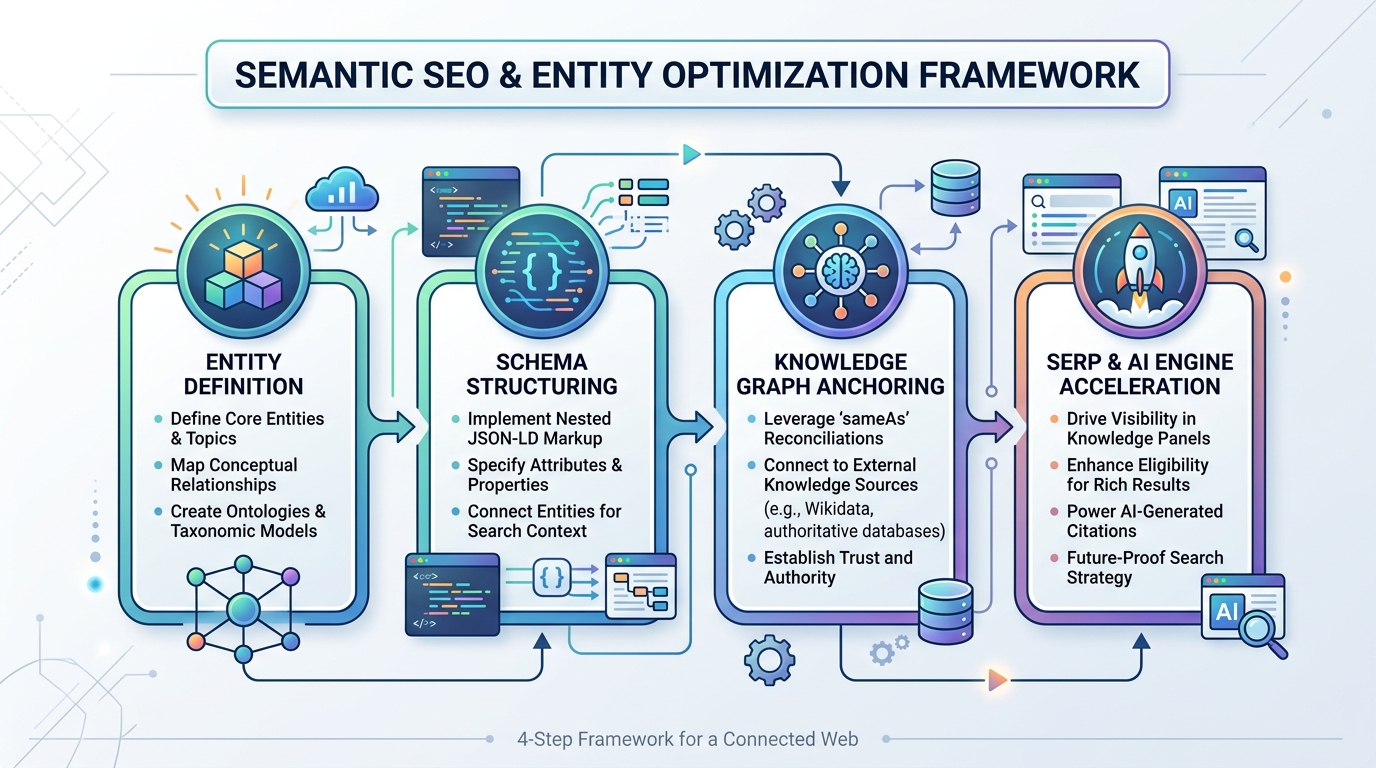
The 4-Step Semantic SEO & Entity Optimization Framework: Entity Definition, Nested JSON-LD Structuring, Knowledge Graph Anchoring, and SERP & AI Engine Acceleration.
1. Entity Definition & Domain Ontology Mapping
Before implementing code, an organization must define its semantic ecosystem. An entity is formally described in computer science as a distinct item that can be uniquely characterized by attributes and real-world relationships. Enterprise teams must map out four core entity tiers:
- The Root Corporate Entity: Official registered legal name, persistent corporate identifier, headquarters location, parent organization, subsidiaries, and official founding details.
- Key Individual Entities: Founders, C-suite executives, and specialized subject-matter experts whose verified credentials establish E-E-A-T (Experience, Expertise, Authoritativeness, and Trustworthiness).
- Commercial & Technical Entities: Flagship software platforms, proprietary service frameworks, patents, and core business offerings.
- Topical Domain Entities: The precise industry disciplines, technologies, and concepts your company commands (e.g., "Distributed Systems Architecture," "Clinical Trial Automation," or "Enterprise Identity Governance").
By leveraging official vocabularies established by Schema.org Vocabulary Standards, enterprises can represent real-world organizational dynamics with mathematical precision.
2. Schema Structuring via Nested JSON-LD Linked Data
A common mistake in web development is deploying disconnected schema tags: one standalone script for breadcrumbs, another isolated tag for author data, and a separate script for the article. This creates disconnected "schema silos" that prevent search crawlers from constructing relational context.
Enterprise semantic architecture utilizes Nested Linked Data written in JSON-LD (JavaScript Object Notation for Linked Data). By assigning persistent Uniform Resource Identifiers (URIs) through the @id attribute, all schemas interlock into a unified web graph:
- Persistent Entity URI: Define a single canonical root entity identifier (such as https://example.com/#organization) referenced across every template on the domain.
- Explicit Author & Publisher Relational Nodes: Connect technical articles directly to the organization’s persistent ID via the publisher property and to verified expert profiles via the author property.
- Contextual About & Mentions Properties: Use about and mentions arrays within page schemas to explicitly declare the primary subject matters discussed, eliminating algorithmic ambiguity.
3. Knowledge Graph Anchoring & Entity Disambiguation (sameAs)
Search algorithms frequently encounter naming ambiguities. Many enterprise names share common words, acronyms, or descriptive phrases with other businesses, geographic locations, or historical terms. If an enterprise lacks clear disambiguation, search engines cannot distinguish it with confidence.
The definitive remedy is Entity Disambiguation using the sameAs array. This property signals to search algorithms: "This entity is identical to the entity cataloged at these recognized reference databases." Essential external authorities include:
- Wikidata: The machine-readable database of the Wikimedia Foundation. Connecting your entity to its corresponding Wikidata QID (e.g., https://www.wikidata.org/wiki/Q...) provides the highest tier of algorithmic confirmation.
- Google Knowledge Graph Search API ID: Directly referencing your verified Google Knowledge Graph Machine ID (kgmid).
- Established Industry Repositories: Official corporate listings across Crunchbase, Bloomberg, LinkedIn Company Pages, and recognized industry accreditation directories.
Official technical guidelines from Google Search Central Structured Data Documentation highlight that multi-source corroboration removes algorithmic uncertainty, directly unlocking Knowledge Panel eligibility.
4. SERP Dominance & AI Engine Citation Acceleration
The commercial benefit of advanced semantic SEO is visual and informational dominance across search results. Standard organic links achieve average click-through rates of 2% to 4%. When powered by comprehensive schema and knowledge graph presence, CTRs routinely reach 8% to 18%:
- Verified Brand Knowledge Panels: Command the prominent desktop knowledge card for branded queries, highlighting leadership, social profiles, subsidiaries, and corporate headquarters.
- Rich Review & AggregateRating Snippets: Display verified star ratings and feedback metrics directly within search listings, immediately validating social proof.
- Interactive FAQ & Sitelinks Search Modules: Expand vertical screen presence with structured FAQ dropdowns and embedded site search capabilities directly inside search engine listings.
- AI Overview & LLM Extraction: When Large Language Models construct answers, they rely on disambiguated semantic nodes to extract accurate facts without hallucination, citing structured enterprises as primary source authorities.
Strategic Value for Modern Enterprises
As organic search undergoes rapid technical evolution, semantic Knowledge Graph optimization delivers three strategic advantages:
- Protection Against Generative AI Search Disruption: AI search interfaces do not scan search results like humans; they query vector databases and construct summaries from authoritative knowledge graphs. Organizations with disambiguated entity records are cited as definitive source material, while unstructured sites are overlooked.
- Reduced Reliance on Paid Ad Auctions: In enterprise technology, legal, healthcare, and finance sectors, paid search ad costs continue to climb. Dominating Knowledge Panels, sitelinks, and rich snippets captures executive search intent at zero marginal media spend.
- Institutional Credibility for High-Value Decision Making: Enterprise buyers and B2B procurement teams perform rigorous due diligence. A verified Google Knowledge Panel linked to global databases signals financial stability, operational maturity, and category authority.
Technical Safeguards: Preventing Structured Data Violations
While advanced schema is transformative, improper or manipulative implementations carry severe risks. Search engines actively penalize structured data spam, issuing manual actions that eliminate rich snippets across entire domains.
To ensure enterprise-grade structured data hygiene:
- Maintain Strict Content Parity: Every property declared in JSON-LD (pricing, reviews, leadership credentials, specifications) MUST be visible to human users on the rendered page. Hiding markup solely for search engines violates search guidelines.
- Avoid Schema Misattribution: Do not apply speculative or inaccurate entity classifications. Utilize the most specific valid type available within the Schema.org taxonomy.
- Continuous CI/CD Schema Validation: Integrate automated schema testing into continuous deployment pipelines using the Official Schema.org Validator and Google Rich Results Test to catch syntax issues and missing fields prior to release.
Why Partner with Nrootz for Semantic SEO & Knowledge Graph Architecture
At Nrootz, we treat search engine optimization as a software engineering and ontological modeling discipline. Most digital agencies remain focused on superficial keyword repetition and generic third-party plugins that fail to connect enterprise data at scale.
Our engineering and growth teams specialize in architecting custom nested JSON-LD linked data systems, executing Wikidata entity reconciliation, and building high-performance modern web platforms that dominate search results and AI answer engines. Whether scaling a specialized technology venture or transforming an established enterprise brand, Nrootz delivers the semantic technical foundation required to establish lasting category authority.
Frequently Asked Questions (FAQ)
What is the key difference between standard Schema markup and Knowledge Graph SEO?
Standard Schema markup involves placing isolated code snippets on specific pages to earn simple rich results like recipe cards or star ratings. Knowledge Graph SEO is an organization-wide data architecture strategy that connects all corporate assets, executives, and services into an interconnected entity graph using persistent @id tags and external reconciliation (such as Wikidata and SameAs properties), establishing your company as an indisputable institutional entity in search engine knowledge vaults.
How does an organization earn a verified Google Knowledge Panel?
A Knowledge Panel cannot be purchased. It is generated algorithmically when search engines accumulate high confidence regarding an entity’s identity, verified attributes, and third-party corroboration. Achieving this requires creating a structured Wikidata entry, earning citations in recognized industry publications, deploying unified Organization JSON-LD markup with comprehensive sameAs links, and maintaining consistent data across corporate registries.
Why is JSON-LD preferred over Microdata or RDFa formats?
JSON-LD is officially recommended by Google Search Central because it cleanly separates metadata from visual HTML. Unlike Microdata, which intertwines attributes inside frontend visual tags and frequently breaks during layout redesigns, JSON-LD resides cleanly within a standalone script block, making it easier to maintain, dynamically generate via backend APIs, and validate automatically.
How long does it take for search engines to reflect advanced Schema markup updates?
Once structured JSON-LD code is published and crawled, basic rich snippets (such as BreadcrumbList, FAQPage, or Review ratings) typically appear in search results within 3 to 14 days. Building a new Knowledge Panel or updating an existing Knowledge Graph entity usually requires 4 to 8 weeks of consistent crawling and multi-source corroboration.
How does advanced Schema markup improve visibility in AI search engines?
Generative AI search engines rely on vector embeddings and structured knowledge graphs to synthesize accurate answers without hallucination. By providing clean, disambiguated entity data and explicitly declaring relationships through schema markup, you make it straightforward for Large Language Models to extract, verify, and cite your brand as an authoritative source for specialized industry queries.