Your Google Ads dashboard reports conversions. Instagram generates enquiries. Your website receives visitors. But when a customer finally makes a purchase, can you confidently explain which marketing activities helped bring them there?
Imagine running a business in Kochi.
You invest ₹30,000 in Google Ads, ₹20,000 in Meta Ads and another ₹15,000 in content creation and SEO every month.
That’s ₹65,000 spent on marketing before accounting for other costs.
At the end of the month, you review your reports.
Google Ads shows 45 conversions. Meta Ads reports 60 leads. Your website receives 4,000 visitors. Your sales team says 25 new customers have purchased.
Everything looks reasonably promising.
Until someone asks a simple question:
Which marketing channel actually generated those 25 customers?
The Google Ads manager points to the conversion dashboard.
The social media team highlights the Instagram enquiries.
Your salesperson says most customers contacted the company through WhatsApp.
And your business partner believes word of mouth is responsible for most sales.
Everyone has a different answer.
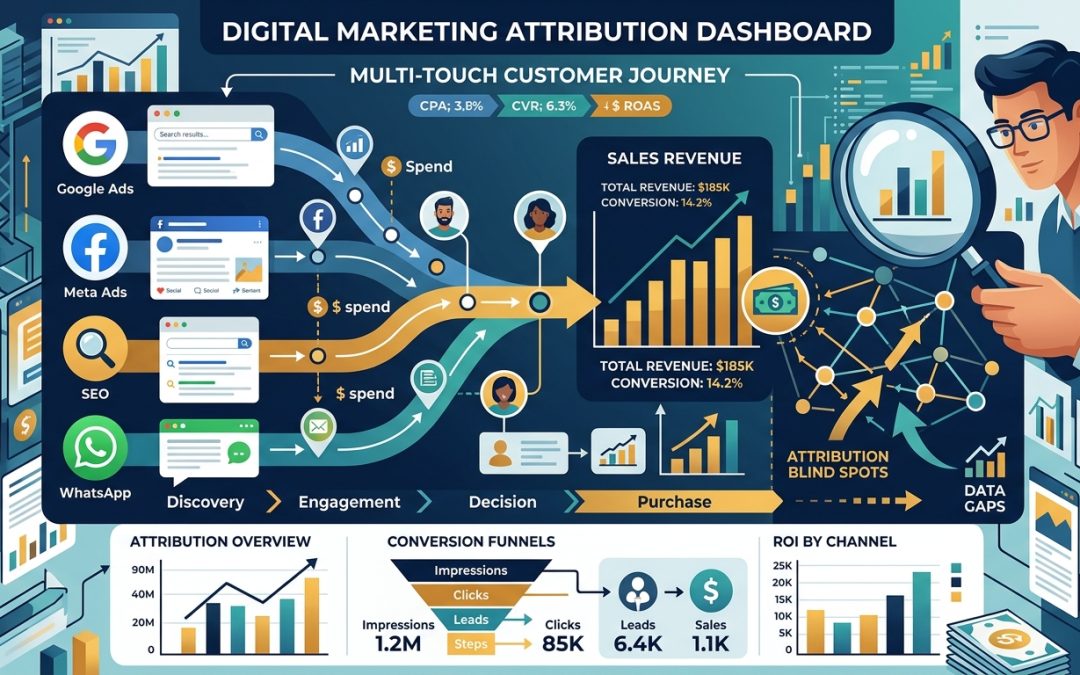
The problem isn’t necessarily that someone is wrong. They may each be looking at a different part of the same customer journey.
This is the digital attribution blind spot.
And it can quietly influence how businesses allocate thousands or even lakhs of rupees in marketing budgets.
1. The Customer Journey Is Rarely a Straight Line
Businesses often imagine marketing as a simple sequence:
An advertisement appears. A customer clicks. The customer purchases.
That happens, particularly with certain high-intent products. But many buying decisions involve several interactions spread across different platforms and days.
Consider a homeowner looking for a rooftop solar installation company in Kerala.
On Monday, she searches Google for information about solar panel costs. She visits a company’s website but doesn’t enquire.
On Wednesday, she notices an Instagram advertisement from the same company and watches a short installation video.
On Friday, she searches the company’s name, reads its Google reviews and compares it with two competitors.
On Saturday, she returns to the website and clicks the WhatsApp button.
The salesperson sends a quotation.
The following week, after discussing the installation with her family, she confirms the order over the phone.
The journey looks like this:
Google Search → Website → Instagram → Google Reviews → Website → WhatsApp → Phone Call → Sale
Now consider what each system might report.
Google Analytics may record website visits and the WhatsApp click.
Meta Ads may attribute a lead or conversion according to its reporting settings and eligible interactions.
Google Ads may report an attributed conversion if the relevant conversion action and attribution conditions are met.
The sales team records one completed installation.
Those figures are not automatically comparable, and adding the platforms’ conversion totals together could double-count the same customer.
This is why marketing attribution matters.
It helps businesses understand the relationship between marketing interactions and valuable customer actions.
Importantly, attribution is not the same as proving that a particular advertisement caused a sale. It is a measurement framework, not a perfect reconstruction of human decision-making.
2. What Is Marketing Attribution?
Marketing attribution is the process of assigning credit to marketing interactions that contribute to a desired outcome.
That outcome might be a purchase, qualified enquiry, booked appointment, subscription or signed contract.
For example, if someone discovers your business through organic search, later clicks a paid advertisement and finally completes a booking, attribution determines how the recorded interactions receive credit.
Different models can produce different answers.
Last-click attribution
In a simplified last-click model, the final eligible marketing interaction receives the credit.
Imagine this journey:
Instagram → Organic Google Search → Paid Google Ad → Enquiry
A last-click approach would give the eligible final Google Ads interaction the credit.
This is straightforward, but it can underrepresent earlier interactions that introduced the customer to the business.
Data-driven attribution
Data-driven attribution uses available conversion-path data and statistical modelling to distribute credit across eligible interactions.
Google Analytics 4 supports data-driven attribution and paid-and-organic last-click reporting. Older models such as linear, time decay and position-based attribution are no longer available as selectable GA4 reporting models.
Data-driven attribution can provide additional perspective, but it remains dependent on the interactions Google can observe and the quality of the implementation.
The business lesson
No attribution model knows everything.
A customer might have received a recommendation from a friend, seen a roadside sign or discussed your business with a colleague. Those influences may never appear in an analytics report.
The objective is not to produce an imaginary 100% accurate customer history.
It is to make substantially better decisions using the evidence available.
3. Why Marketing Dashboards Can Tell Different Stories
A common mistake is treating every reported conversion as a completed sale.
They are not necessarily the same.
A Google Ads conversion might represent a submitted form, a phone call, an online purchase or another configured action.
A Meta Ads lead might represent an instant form submission, a website event or another eligible result.
A GA4 key event might represent a completed purchase, a submitted enquiry or a specific action the business has marked as important.
A CRM sale is a separate business outcome.
If your website tracks WhatsApp button clicks, one visitor could click the button three times without sending a single message.
The analytics platform might record those clicks. Your business might receive no enquiry.
Likewise, a form submission can be duplicated, spam, irrelevant or never converted into a paying customer.
A tracked interaction is not automatically a qualified lead. And a qualified lead is not automatically revenue.
This distinction should influence every marketing report your business reviews.
4. A ₹65,000 Marketing Budget: Which Channel Is Really Performing?
Let’s use a hypothetical example.
A Kerala service business invests ₹65,000 across three marketing activities.
|
Marketing channel |
Monthly cost |
Recorded enquiries |
Customers acquired |
|
Google Ads |
₹30,000 |
60 |
12 |
|
Meta Ads |
₹20,000 |
100 |
5 |
|
SEO and content |
₹15,000 |
30 |
8 |
|
Total |
₹65,000 |
190 |
25 |
Illustrative figures only. Customers are assigned to one channel in this simplified example; real attribution may involve multiple touchpoints.
Looking only at enquiry volume, Meta Ads appears to be the winner.
It generates 100 enquiries for ₹20,000.
Google Ads produces fewer enquiries at a higher cost.
But let’s calculate the actual acquisition costs.
|
Channel |
Cost per enquiry |
Cost per acquired customer |
|
Google Ads |
₹500 |
₹2,500 |
|
Meta Ads |
₹200 |
₹4,000 |
|
SEO and content |
₹500 |
₹1,875 |
The interpretation changes.
Meta Ads delivers the cheapest enquiries but the highest acquisition cost among these channels.
SEO and content produce fewer enquiries, yet the assigned customers have the lowest acquisition cost for this particular month.
Does that mean the company should immediately stop Meta Ads?
No.
Meta might be introducing customers who later convert through Google. SEO content created in previous months may also be contributing to current sales. And one month’s acquisition cost does not capture the longer-term value of SEO investment.
This is why businesses need to evaluate both immediate performance and the wider customer journey.
The cheapest lead is not necessarily the most valuable lead.
5. The Five Numbers Every Business Owner Should Understand
You do not need to become a data analyst to make better marketing decisions.
Start with five practical measurements.
Cost per lead (CPL)
How much are you spending to generate an enquiry?
CPL = Marketing spend ÷ Number of leads
If you spend ₹20,000 and receive 100 leads, your CPL is ₹200.
However, the calculation becomes more meaningful when duplicate and invalid enquiries are removed.
Lead-to-customer conversion rate
What percentage of your enquiries become paying customers?
Conversion rate = Customers acquired ÷ Leads × 100
If 100 enquiries produce five customers, your conversion rate is 5%.
A business with fewer but better-qualified leads can outperform a business with hundreds of weak enquiries.
Customer acquisition cost (CAC)
How much does it cost to acquire a customer?
CAC = Relevant acquisition costs ÷ New customers acquired
For a complete business-level CAC, include relevant marketing and sales acquisition costs, not advertising spend alone.
Customer lifetime value (CLV)
How much economic value does a customer contribute over the relationship?
A customer who purchases once for ₹2,000 is different from a customer who returns every month for two years.
For sound decisions, consider gross profit or contribution margin, not just revenue.
Return on advertising spend (ROAS)
How much attributed revenue is generated for each rupee of advertising spend?
ROAS = Attributed advertising revenue ÷ Advertising spend
A ROAS of 4 means ₹4 in attributed revenue for every ₹1 of ad spend.
But ROAS is not profit. Product costs, fulfilment, salaries, returns and other expenses still matter.
Together, these measurements provide a better picture than clicks and impressions alone.
6. Google Analytics 4: Installed Does Not Mean Configured
Many businesses have Google Analytics installed on their websites.
Far fewer can confidently explain what their analytics reports mean.
Simply installing GA4 doesn’t guarantee useful measurement.
For example, a business might see:
- 8,000 website sessions
- 6,500 active users
- 15,000 page views
- 200 recorded events
But what happened commercially?
Did visitors request quotations?
Did they submit forms?
Did they book consultations?
Did they make purchases?
Without meaningful event configuration, a business can collect large quantities of data without answering important questions.
What should GA4 track?
The answer depends on your business model.
For a service business, useful events may include successful enquiry submissions, appointment bookings and confirmed lead actions.
For an ecommerce business, useful events include purchases, checkout progress and other relevant shopping interactions.
For a business that depends on WhatsApp, a click on the WhatsApp button can be useful as an engagement indicator. But it should not be labelled a confirmed lead unless a separate process verifies that an enquiry occurred.
Key events versus conversions
In GA4, important user actions can be marked as key events. Google Ads conversions are used for advertising measurement and optimisation.
These concepts are related but should not be treated as identical in every report.
GA4 attribution settings, event scope, reporting identity, consent, data availability and platform-specific conversion settings can affect the numbers shown.
Google’s attribution-path reports can help identify channels that initiate, assist and close recorded key-event journeys.
The crucial word is recorded.
A well-configured analytics system improves visibility. It does not eliminate every measurement gap.
7. The WhatsApp Attribution Problem
For many businesses in Kerala, WhatsApp is one of the most important customer communication channels.
A prospective customer visits the website, clicks WhatsApp, asks for pricing, receives a quotation and eventually purchases.
But the original marketing source is often lost along the way.
The website may know the customer arrived through Google Ads.
The WhatsApp conversation may not preserve that information.
The salesperson may save the contact without recording the enquiry source.
When the sale is completed, the company knows the customer purchased but cannot confidently connect the transaction to its marketing activity.
How to improve WhatsApp lead tracking
Start with a structured process.
Use tagged campaign URLs so website analytics can identify campaign traffic.
Where appropriate, configure website interactions such as WhatsApp button clicks.
Preserve the campaign or landing-page source in your enquiry records when technically possible and permitted.
Give each lead a unique identifier.
Record whether the lead was qualified, quoted, won or lost.
Connect the eventual sales outcome to the original lead record.
For direct click-to-WhatsApp advertising, use the platform’s available messaging and conversion measurement capabilities rather than assuming a website tracking tag can observe the entire conversation.
A CRM becomes valuable here because it can connect marketing information with the actual sales process.
However, a CRM alone does not solve attribution. The business still needs accurate data collection, sensible integrations and consistent use by employees.
8. The Offline Sales Gap
Consider an interior design company.
A potential customer discovers the company through Google Search, views its portfolio, calls the office and books a consultation.
Three weeks later, the customer signs a ₹4 lakh project agreement.
If the company tracks only website form submissions, that sale may never be connected to the original marketing activity.
This is particularly relevant to businesses where transactions happen after consultations, site visits, negotiations or quotations.
Examples include construction, education, solar installation, B2B services, real estate and professional services.
What can businesses do?
A practical starting point is to record the original enquiry source and the final sale in one system.
For businesses using Google Ads, enhanced conversions for leads and supported offline conversion imports can help connect eligible offline outcomes to advertising interactions.
These systems require correct implementation, suitable customer data, appropriate permissions and compliance with applicable privacy requirements.
The objective is to move beyond measuring only who clicked an advertisement.
You want to understand which advertising activity contributed to genuine business outcomes.
9. Seven Attribution Mistakes That Distort Marketing Decisions
Mistake 1: Counting every form submission as a customer
An enquiry is not a sale.
Separate lead generation from customer acquisition.
Mistake 2: Treating every WhatsApp click as a qualified lead
A click may not result in a message.
Use a more meaningful lead qualification process.
Mistake 3: Adding conversion totals from different advertising platforms
Google Ads and Meta Ads may both report credit for interactions involving the same customer.
Platform totals are not automatically deduplicated across systems.
Mistake 4: Ignoring organic search because paid advertising shows immediate results
SEO can contribute to awareness, evaluation and conversion over time.
Assess it over an appropriate period.
Mistake 5: Making budget decisions from one week’s data
Small samples, seasonal changes and longer sales cycles can distort short-term results.
Mistake 6: Failing to connect marketing with sales records
If the sales team cannot identify which leads became customers, marketing reporting remains incomplete.
Mistake 7: Assuming attribution proves causation
An attribution report assigns credit according to its rules and observed data.
To understand whether advertising generated additional sales that would not otherwise have occurred, businesses may also need controlled experiments, geographic tests or other incrementality measurement approaches.
This is especially important when increasing budgets substantially.
10. How to Build a Practical Marketing Measurement System
You do not need an expensive enterprise analytics platform to begin.
A small business can start with a carefully configured website, GA4, Google Tag Manager, consistent campaign tracking and a simple CRM or lead register.
The system should connect five stages.
Stage 1: Discovery
Where did the customer first encounter your business, to the extent you can observe or reliably ask?
Possible sources include Google Search, Google Ads, Instagram, referrals and direct visits.
Stage 2: Enquiry
What action did the customer take?
A form submission, phone call, appointment booking or WhatsApp conversation?
Stage 3: Qualification
Was the enquiry genuine and relevant?
Did the customer have a suitable requirement, budget and timeline?
Stage 4: Sales progression
Was a quotation sent?
Was a meeting booked?
Did the customer negotiate, postpone or decline?
Stage 5: Revenue
Did the enquiry become a sale?
What was the transaction value?
What was the estimated margin?
These stages turn disconnected marketing statistics into a more useful business picture.
Example: A simple lead-tracking record
|
Field |
Example |
|
Lead ID |
NR-1025 |
|
Enquiry date |
13 October 2026 |
|
Source |
Google Ads |
|
Campaign |
Solar Installation Kochi |
|
Enquiry method |
Website form |
|
Lead status |
Qualified |
|
Quotation value |
₹1,80,000 |
|
Sales status |
Won |
|
Final sale value |
₹1,65,000 |
Illustrative record.
Even this basic structure is more useful than a monthly report containing only impressions, clicks and leads.
Over time, it allows a business to examine which sources produce qualified opportunities and completed transactions.
11. Your 15-Point Marketing Attribution Audit
Before increasing your advertising budget, review the following questions.
Website and analytics
- ☐ Is GA4 collecting data correctly across important pages?
- ☐ Are enquiry forms tracked only when submissions succeed?
- ☐ Are important actions configured as meaningful key events?
- ☐ Are campaign URLs consistently tagged?
- ☐ Have duplicate conversion events been investigated?
Advertising
- ☐ Do Google Ads and Meta Ads have appropriate conversion goals?
- ☐ Are we distinguishing enquiries from completed sales?
- ☐ Are we reviewing conversion quality, not just quantity?
- ☐ Do we understand the attribution settings used by each platform?
- ☐ Are campaign results evaluated over a suitable sales cycle?
Sales and CRM
- ☐ Does every genuine enquiry receive a lead record?
- ☐ Is the original source recorded where available?
- ☐ Are qualified leads and quotations tracked?
- ☐ Can completed sales be connected to lead records?
- ☐ Do marketing and sales teams review results together?
If several answers are no, the first priority may not be another advertising campaign.
It may be fixing the measurement process.
12. What About Customer Privacy?
Better tracking does not mean collecting every possible piece of customer information.
Businesses should understand which data they collect, why it is necessary, how long it is retained and who can access it.
In India, organisations need to consider applicable requirements under the Digital Personal Data Protection framework and other relevant rules.
Businesses serving customers in Ireland, the EU or UK may also have GDPR, UK GDPR and electronic-communications requirements.
Analytics tags, advertising pixels, CRM integrations and enhanced conversion features should be implemented with appropriate consent and privacy controls where required.
Personal information should not be inserted into ordinary campaign URLs or exposed through analytics parameters.
The aim is responsible measurement, not unrestricted surveillance.
13. What a Useful Marketing Dashboard Should Actually Show
Imagine opening a dashboard on Monday morning.
Instead of seeing only advertising spend and clicks, you can review:
|
Business metric |
What it helps answer |
|
Marketing spend |
How much did we invest? |
|
Genuine enquiries |
How much demand did we generate? |
|
Qualified leads |
How relevant were those enquiries? |
|
Cost per qualified lead |
Which channels generate suitable opportunities efficiently? |
|
Quotations issued |
How many leads progressed? |
|
Customers acquired |
How many opportunities became sales? |
|
Acquisition cost |
What did acquiring those customers cost? |
|
Revenue and margin |
What financial value did they create? |
You could then investigate why one campaign generated 100 enquiries but only two customers, while another produced 20 enquiries and eight customers.
Perhaps the first campaign attracted the wrong audience.
Perhaps its advertisement created unrealistic expectations.
Perhaps the sales team responded too slowly.
Or perhaps the customers needed more time to make a decision.
A dashboard does not automatically explain the reason.
It tells you where to investigate.
That is the difference between collecting data and using it.
14. How Nrootz Approaches Marketing Measurement
At Nrootz, we believe a marketing report should help a business owner make decisions, not simply demonstrate that advertising activity took place.
That means looking beyond surface-level metrics.
Our digital marketing, analytics and technology services can support businesses in areas such as:
Website and conversion measurement: Reviewing how websites capture enquiries and whether important actions are tracked correctly.
Google Analytics and Tag Manager: Helping establish more meaningful website and campaign measurement.
Performance marketing: Evaluating campaign results in the context of lead quality and business outcomes.
CRM and lead management: Improving how enquiries move from the first interaction to the sales process.
Business reporting: Bringing useful marketing and sales information into clearer reports and dashboards.
Automation and integration: Identifying opportunities to reduce manual data handling and improve consistency.
The appropriate solution depends on the business. Some companies need a tracking configuration review. Others need a better lead register, improved CRM adoption or a broader reporting framework.
Not every business needs complex software.
But every growing business benefits from understanding what its marketing investment is producing.
15. Before You Increase Your Marketing Budget, Ask These Questions
Before approving your next campaign, ask your team:
How many genuine enquiries did we generate last month?
How many were qualified?
How many became customers?
Which channels were involved in those journeys?
What did acquiring those customers cost?
Which figures are directly measured, and which are estimates?
What information are we missing?
These questions may be more valuable than another report celebrating thousands of impressions.
Because a business doesn’t grow simply by attracting attention.
It grows when the right attention leads to profitable customer relationships.
Final Thoughts: Stop Guessing. Start Connecting the Dots.
Your customers rarely move through your marketing exactly as your dashboards suggest.
They discover you in one place, investigate you somewhere else, contact you through another channel and sometimes purchase days or weeks later.
Google Ads might introduce them.
Your website might build confidence.
Instagram might remind them.
Reviews might influence their decision.
WhatsApp might begin the conversation.
And your sales team might close the deal.
The challenge is understanding how these pieces fit together.
Perfect attribution is rarely possible.
But better measurement is achievable.
And when you connect marketing activity with genuine enquiries, qualified opportunities and completed sales, your budget decisions become more informed.
Before asking where to spend more on marketing, find out what your existing marketing is actually delivering.
Need a Clearer Picture of Your Marketing Performance?
Nrootz helps businesses review their digital measurement foundations, identify tracking gaps and build more useful connections between websites, campaigns, enquiries and sales reporting.
Explore Nrootz’s Analytics & Reporting and Digital Marketing services at nrootz.in, or contact our team to discuss a marketing measurement review.
Frequently Asked Questions
What is marketing attribution?
Marketing attribution is the process of assigning credit to recorded marketing interactions that contribute to a desired action, such as an enquiry, booking or purchase.
What is the difference between GA4 and Google Ads conversion tracking?
GA4 measures website and app interactions across supported sources, while Google Ads conversion tracking focuses on outcomes relevant to advertising measurement and optimisation. Their reported figures may differ because of settings, attribution, scope and data availability.
Can Google Analytics track WhatsApp enquiries?
GA4 can track website interactions such as WhatsApp button clicks when configured correctly. It cannot automatically confirm that every click became a WhatsApp conversation or sale. Additional integration or CRM tracking is needed for deeper measurement.
Why do Meta Ads and Google Analytics show different conversions?
They use different measurement systems, attribution rules, reporting windows and available interaction data. Differences do not necessarily mean either system is broken.
What is the difference between CPL and CAC?
Cost per lead measures spending per enquiry. Customer acquisition cost measures the relevant costs of acquiring a paying customer. A low CPL does not guarantee a low CAC.
Is GA4 enough for marketing attribution?
GA4 is useful for digital interaction and attribution analysis, but it cannot automatically observe every offline conversation, referral or completed sale. Businesses with offline sales often benefit from connecting analytics with CRM and sales records.
Do small businesses need a CRM?
Not always an expensive one. A simple, consistently maintained lead register may be sufficient initially. As enquiry volume, team size and sales complexity grow, a CRM can make tracking and follow-up more manageable.
How often should businesses review marketing attribution?
Basic tracking health should be checked regularly. Campaign performance can be reviewed weekly or monthly, while major budget decisions should consider sales-cycle length, sample size, seasonal patterns and profitability.
Can marketing attribution guarantee better sales?
No. Attribution helps explain recorded customer journeys and supports better decisions. Sales growth also depends on product-market fit, pricing, customer experience, sales execution and other factors.