
Introduction: The Collapse of the "Spray-and-Pray" B2B Lead Funnel
For more than a decade, the standard B2B marketing playbook relied on a brute-force volume game: cast a wide net with broad digital ads, collect thousands of email addresses through gated generic eBooks or webinars, label them "Marketing Qualified Leads" (MQLs), and dump them into the CRM for sales reps to cold call. In high-velocity low-ticket SaaS or transactional consumer products, volume-based funnels can sometimes yield modest returns.
However, for enterprise software providers, high-ticket technology consultancies, cloud engineering agencies, and bespoke corporate solution vendors selling contracts valued between $50,000 and $1,000,000+, this traditional lead generation model is fundamentally broken. Sales teams spend hundreds of hours chasing unvetted contacts, junior interns, or academic researchers who will never hold purchasing authority, while genuine enterprise decision-makers ignore generic cold outreach completely.
According to comprehensive research by Gartner on the Modern B2B Buying Journey, the typical enterprise buying committee consists of 6 to 10 cross-functional stakeholders (spanning engineering, finance, cybersecurity, and operations), each armed with 4 to 5 pieces of independently gathered digital research. Furthermore, B2B buyers spend only 17% of their total purchasing journey meeting with potential suppliers; when comparing multiple vendors, any single sales team receives roughly 5% to 6% of that customer's time.
Benchmark economic reports published by Forrester Research on Account-Based Marketing demonstrate that organizations executing intent-driven ABM achieve a 91% increase in average deal size and a 300% lift in marketing-driven pipeline velocity. Rather than waiting passively for an anonymous buyer to fill out a website contact form, Account-Based Marketing (ABM) flips the traditional funnel: you identify high-fit target accounts upfront, detect their surging market intent, deliver hyper-personalized digital experiences across every touchpoint, and engage buying committees before your competitors even know they are looking.
Enterprise Growth Truth: Winning six-figure and seven-figure B2B contracts is not an advertising volume contest; it is a synchronized precision pursuit. When real-time buyer intent data, dynamic web personalization, programmatic ad orchestration, and executive sales outreach align on high-priority accounts, enterprise pipeline conversion and annual contract values compound exponentially.
Traditional B2B Lead Gen vs. Intent-Driven Account-Based Marketing (ABM)
Compare the operational mechanisms and commercial results of traditional volume-based lead generation against modern intent-driven ABM:
|
Growth Dimension |
Traditional B2B Lead Gen (Volume Funnel) |
Intent-Driven ABM (Precision Funnel) |
|
Target Audience Definition |
Broad personas, general job titles, and mass geographic demographics. |
Curated list of named target enterprise accounts strictly matching the Ideal Customer Profile (ICP). |
|
Primary Success Metrics |
Raw MQL count, cost per click (CPC), and form submission volume. |
Account Engagement Score, Buying Committee Penetration, Pipeline Velocity, and Annual Contract Value (ACV). |
|
Sales & Marketing Alignment |
Siloed operations; marketing blames sales for unworked leads, sales blames marketing for poor lead quality. |
Unified "One Revenue Team"; shared target account list, synchronized cadences, and joint revenue quotas. |
|
Digital Content & Landing Pages |
Generic, static landing pages built for broad appeals with one-size-fits-all messaging. |
Dynamic web personalization displaying target account company names, industry case studies, and custom ROI models. |
|
Outreach Trigger Mechanism |
Passive; waiting for a prospect to trigger an inbound form or unprompted cold email blasting. |
Proactive; triggered automatically when surging first-party or third-party intent signals cross activation thresholds. |
|
Win Rate & Retention Economics |
Low win rates (under 12%); high churn due to poorly qualified customer expectations. |
High win rates (38% to 55%); 2.5x higher contract values and compounding multi-year expansion retention. |
The 5-Stage Enterprise ABM Execution Framework
Executing a world-class ABM motion requires transforming your revenue engine into an orchestrated intelligence system. High-growth B2B organizations operationalize their campaigns across five structured stages:
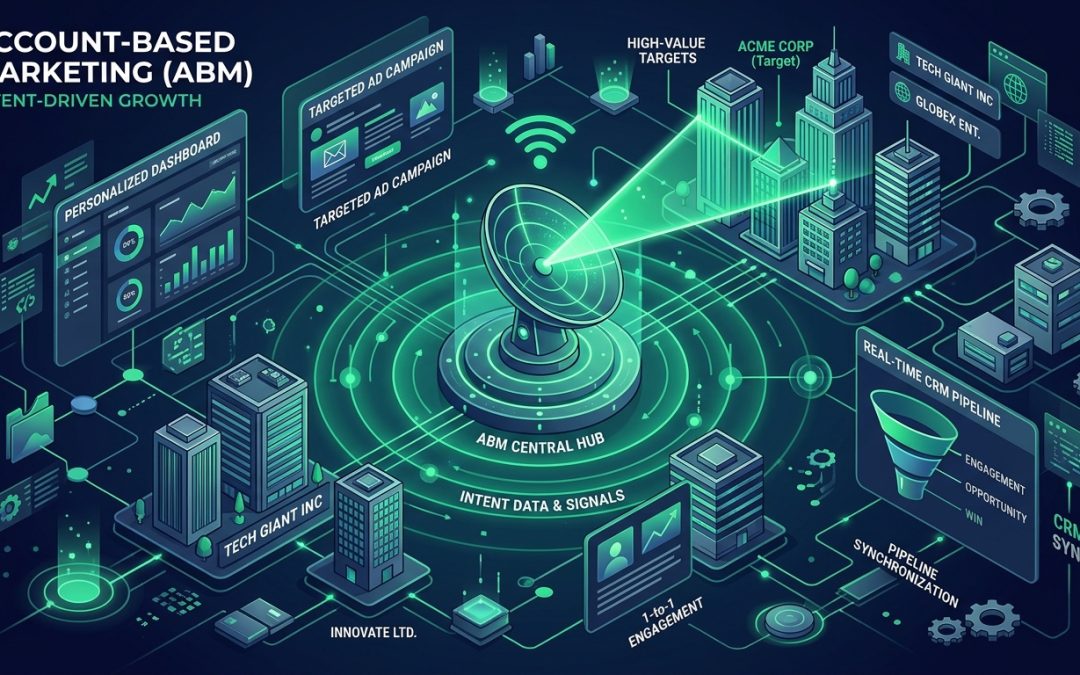
The 5-Stage B2B ABM Execution Framework: from ICP modeling and intent signal detection to personalized multi-channel orchestration, sales alignment, and closed-loop revenue attribution.
1. Ideal Customer Profile (ICP) Modeling & 3-Tier Account Segmentation
ABM fails when teams attempt to treat every prospect identically. Sustainable programs segment target accounts into three distinct operating tiers based on contract potential and resource investment:
- Tier 1: Strategic 1-to-1 ABM (Top 10–50 Accounts): High-value enterprise prospects with potential contract values exceeding $250,000+. Every single account receives bespoke industry research, custom executive landing pages, tailored video briefings, and bespoke ROI financial models.
- Tier 2: ABM-Lite / 1-to-Few (100–500 Accounts): Grouped into tight micro-clusters based on shared industry verticals, technology stacks, or regulatory pressures (e.g., "Healthcare providers migrating from monolithic EHR to cloud APIs"). Messaging and landing pages are customized by segment.
- Tier 3: Programmatic 1-to-Many ABM (1,000+ Accounts): Automated intent-driven campaigns leveraging IP-targeted programmatic advertising, automated LinkedIn Matched Audiences, and dynamic website personalization rules driven by automated CRM triggers.
2. Intent Signal Detection: Decoding the Invisible Enterprise Buyer
Long before an enterprise contact downloads a brochure, members of their buying committee are already actively researching solutions across the digital ecosystem. Capturing these early-stage footprints requires uniting two distinct data streams:
- First-Party Intent Data (On-Site Telemetry): Using reverse-IP lookup technologies (such as Clearbit, 6sense, or Snitcher), deanonymize corporate traffic visiting your website. Identify which target accounts are reading your API documentation, visiting your pricing tier pages, or reviewing high-value case studies—even if they never submit a contact form.
- Third-Party Intent Data (Off-Site Market Intelligence): Aggregated from platforms like Bombora or G2, third-party intent monitors spikes in content consumption across thousands of business publications. When an enterprise's employees suddenly consume 300% more articles regarding "Headless CMS migration" or "B2B payment automation," their intent score surges, signaling an active buying cycle.
3. Orchestrated Multi-Channel Digital Engagement
Once an account demonstrates high buying intent, marketing deploys a synchronized, multi-channel surround-sound campaign. Insights from the LinkedIn B2B Marketing Institute on B2B Buying Cycles emphasize that building consensus across 10 committee members requires consistent, multi-touch visual reinforcement:
- Programmatic IP-Targeted Display: Deliver non-intrusive, thought-leadership ads exclusively to devices operating on the target company's corporate IP network and remote employee VPNs.
- LinkedIn Matched Audience Precision: Target C-level executives, VP of Engineering, VP of Marketing, and Head of Procurement at the specific account with differentiated ad copy tailored to their organizational pain points.
- Dynamic Landing Page Personalization: When a visitor from a Tier-1 account clicks through, edge middleware dynamically renders their corporate logo, displays customer case studies from their exact vertical, and introduces the dedicated solutions engineer assigned to their company.
4. Sales & Marketing "One-Revenue-Team" Cadence
The fatal breakdown in traditional B2B marketing occurs during the handoff from marketing to sales. In an advanced ABM motion, there is no handoff; marketing and sales operate in complete lockstep:
- Intent-Triggered Outreach Alerts: When an account's combined engagement score exceeds a defined threshold (e.g., three separate stakeholders visit high-intent web pages within 48 hours), an automated Slack or CRM alert notifies the designated Account Executive (AE) and Business Development Rep (BDR).
- Context-Aware Executive Inquiries: Instead of generic cold scripts ("Just checking in to see if you have 15 minutes"), the sales rep reaches out with actionable, context-rich commentary: "We noticed your engineering team is evaluating headless CMS frameworks; here is a private architectural benchmark comparing Next.js edge caching against monolithic database queries."
5. Pipeline Velocity, Deal Expansion & Closed-Loop Attribution
ABM measurement requires retiring simplistic "first-click" or "last-touch" attribution models. Enterprise buying journeys are multi-month marathons spanning dozens of micro-interactions. High-growth teams evaluate performance through three quantitative pillars:
- Account Coverage Rate: The percentage of key buying committee roles engaged within each target enterprise account.
- Pipeline Velocity Acceleration: The number of days elapsed from initial intent signal detection to qualified pipeline opportunity creation and final contract signature.
- Deal Size Expansion (ACV): Demonstrating that ABM accounts close at significantly higher contract values compared to non-targeted inbound opportunities.
The Modern ABM Technology Stack: Architecture & Tooling Matrix
Executing an automated, intent-driven ABM program requires an integrated software stack that connects data intelligence directly to dynamic web experiences. Review the essential technology layers:
|
ABM Tech Stack Layer |
Core Functional Capability |
Representative Platforms |
Strategic Engineering Insight |
|
Account Intelligence & ICP |
Firmographic data enrichment, revenue sizing, tech stack profiling. |
ZoomInfo, Clearbit, Apollo, Crunchbase |
Enrich CRM account records automatically to verify tech stack compatibility before launching outreach. |
|
Intent Data & Signal Scoring |
First-party IP deanonymization and third-party content consumption spikes. |
Bombora, 6sense, Demandbase, Leadfeeder |
Establish automated threshold triggers that automatically move accounts from "Unaware" to "Active Intent" stage. |
|
Dynamic Web Personalization |
Real-time on-page copy, asset, and case study swapping based on visitor company domain. |
Mutiny, Ninetailed, Next.js Edge Middleware |
Execute personalization at the edge to ensure zero layout shift (CLS = 0) and maintain sub-second load speeds. |
|
Paid Channel Orchestration |
Targeted programmatic display, LinkedIn matched audience syncing, IP advertising. |
LinkedIn Campaign Manager, Terminus, RollWorks |
Dynamically refresh audience lists daily via API connectors based on changing account intent scores. |
|
CRM & Revenue Operations |
Single source of truth for account scoring, sales alerting, and pipeline attribution. |
HubSpot CRM, Salesforce, Marketo |
Connect Closed-Loop Offline Conversion Imports (OCI) to feed closed deal data back to ad algorithms. |
Critical Pitfalls That Derail Enterprise ABM Programs
Even well-funded organizations frequently struggle with ABM implementation due to common operational missteps. Guard against these four high-risk errors:
- Treating ABM as Solely a Marketing Initiative: If sales leadership is not involved in selecting target accounts, defining intent scoring criteria, and committing to immediate follow-up cadences, the initiative will fail. ABM is an organizational revenue motion, not an ad campaign.
- Targeting Too Many Accounts in Tier 1: Attempting to deliver bespoke 1-to-1 personalization for 500 accounts inevitably dilutes quality, resulting in generic messaging that gets ignored. Cap Tier 1 at 25 to 50 genuinely high-value accounts that warrant deep custom research.
- Neglecting Post-Click Landing Page Experiences: Driving high-value enterprise decision-makers from laser-focused LinkedIn ads to a generic homepage with broad consumer copy destroys conversion momentum. Every campaign must route to an account-relevant, customized digital environment.
- Premature Cancellation Due to Extended B2B Sales Cycles: Six-figure enterprise contracts typically require 3 to 9 months to close. Canceling an ABM pilot after 60 days because deals have not yet signed demonstrates a fundamental misunderstanding of enterprise procurement timelines. Measure leading indicators (account engagement, committee penetration) before evaluating trailing revenue.
Why Partner with Nrootz for Enterprise ABM & B2B Growth Strategy
At Nrootz, we unite cutting-edge web engineering, dynamic landing page architectures, and intent-driven digital marketing to help ambitious B2B enterprises win high-value contracts globally.
Unlike traditional marketing agencies that stop at running generic LinkedIn ads, our growth and technical teams design and deploy end-to-end ABM ecosystems. We engineer high-converting, sub-second personalized web experiences using modern Next.js edge frameworks, configure multi-channel intent data pipelines, integrate closed-loop CRM analytics, and synchronize sales outreach cadences. Whether you are scaling an enterprise SaaS platform or accelerating a global technology services firm, Nrootz delivers the strategic precision and engineering excellence needed to transform target enterprise accounts into long-term closed revenue.
Frequently Asked Questions (FAQ)
What is Account-Based Marketing (ABM) and how does it differ from traditional B2B marketing?
Account-Based Marketing (ABM) is a strategic B2B growth methodology where marketing and sales teams collaborate to treat individual high-value prospect accounts as distinct markets of one. Rather than broadcasting broad marketing messages to attract large volumes of unqualified individual leads, ABM identifies high-fit target enterprise accounts upfront and delivers coordinated, highly personalized marketing and sales touchpoints tailored to the specific buying committee.
What is the difference between Tier 1, Tier 2, and Tier 3 ABM?
Tier 1 (Strategic 1-to-1 ABM) focuses on a select group of 10 to 50 enterprise targets, with completely bespoke messaging, custom landing pages, and individual account research. Tier 2 (ABM-Lite or 1-to-Few) groups 100 to 500 accounts into tightly defined vertical or pain-point clusters that share customized collateral. Tier 3 (Programmatic ABM) applies intent data and automated ad targeting to engage 1,000+ accounts at scale using dynamic web personalization rules.
How does intent data detect when a target company is actively evaluating vendors?
Intent data operates through two main streams: First-party intent identifies visiting companies via reverse-IP lookup on your own website, tracking high-intent behaviors such as visits to pricing pages, API documentation, or customer case studies. Third-party intent aggregates anonymous content consumption spikes across thousands of external business websites, publisher networks, and software review platforms (like Bombora or G2). When a target company's IP address suddenly consumes heavy research on specific industry problem topics, their intent score spikes, signaling an active purchase window.
Why is website personalization essential for successful ABM execution?
Enterprise buyers expect digital experiences that directly acknowledge their unique operational context. When a target enterprise decision-maker visits your site after seeing an account-specific ad, dynamic web personalization ensures they immediately see their company name, industry-specific pain points, relevant regulatory certifications, and vertical case studies. This eliminates friction, immediately establishes enterprise credibility, and increases inquiry conversion rates by up to 40%.
What is the typical timeframe required to generate closed revenue from an ABM program?
Because enterprise B2B sales cycles typically range from 3 to 9 months, closed revenue is a trailing metric. However, leading indicators—such as target account web engagement, intent score surges, and qualified meeting bookings with key buying committee members—typically emerge within the first 45 to 60 days. An optimized ABM program typically achieves full revenue momentum and measurable ACV lift within 6 to 9 months of launch.