Introduction: The Breaking Point of Monolithic Web Platforms
For more than two decades, the global web has been dominated by monolithic content management systems. Platforms such as traditional WordPress, Drupal, monolithic Magento, and legacy enterprise suites were celebrated for packaging everything into a single, tightly coupled codebase: relational databases, server-side template renderers, administrative dashboards, and third-party plugin ecosystems. In the early days of desktop-only web browsing, this all-in-one approach offered convenience and simplicity.
However, the demands of the modern digital economy have fundamentally outpaced monolithic architectures. Today's high-growth enterprises do not publish content for a single desktop web browser. They operate complex digital ecosystems spanning responsive global web applications, native iOS and Android mobile apps, progressive web apps (PWAs), interactive digital kiosks, smartwatch interfaces, customer portals, and AI-driven conversational search agents. Forcing a rigid, database-coupled monolithic CMS to power this multi-device reality inevitably leads to debilitating technical debt.
Market projections published by Gartner on Composable Digital Experience Platforms (DXP) indicate that by 2026, over 80% of digital leaders will abandon monolithic legacy suites in favor of modular, composable web architectures to accelerate feature delivery and eliminate vendor lock-in. When the presentation layer (the "head") is tightly wired to the backend database, any visual iteration requires risky server-level deployments, slow compilation times, and constant plugin patching that threatens site stability.
To overcome these structural bottlenecks, forward-thinking enterprises, fast-growing B2B software companies, and global e-commerce brands are transitioning to Headless CMS and Composable Web Architecture. In this definitive engineering guide, Nrootz unpacks the architectural mechanics of decoupled web engineering, how composability unlocks sub-second Core Web Vitals, and how modern organizations build future-proof digital platforms that scale globally without operational friction.
Composable Architecture Principle: True digital velocity cannot be achieved on coupled, monolithic architectures where a minor frontend visual tweak requires recompiling an entire database or risking plugin conflicts. Modern market leaders separate content management from presentation, delivering sub-second edge speeds and infinite omnichannel flexibility.
Monolithic CMS vs. Composable Headless Architecture: Detailed Comparison
To understand the structural divergence between legacy monoliths and modern composable frameworks, evaluate how both paradigms handle critical engineering dimensions:
|
Architectural Dimension |
Traditional Monolithic CMS (Coupled) |
Composable Headless Architecture (Decoupled) |
|
Frontend / Backend Coupling |
Tightly bound; frontend templates (PHP, Liquid, Blade) are tethered directly to the database layer. |
Completely decoupled; backend exposes structured JSON data via high-speed GraphQL or REST APIs. |
|
Global Performance & TTFB |
Dynamic server queries on each request; Time to First Byte (TTFB) typically ranges from 600ms to 2,500ms. |
Pre-rendered at the edge (SSG/ISR) and cached globally across CDNs; TTFB sub-50ms worldwide. |
|
Omnichannel Distribution |
Outputs only HTML for web browsers; requires redundant databases or brittle middleware for mobile apps. |
Single source of truth; identical content repository powers Web, iOS/Android apps, smartwatch UIs, and IoT. |
|
Security & Attack Surface |
High vulnerability exposure; public administrative endpoints, SQL injection vectors, and outdated third-party plugins. |
Zero direct public database exposure; static assets served from CDN edges; backend CMS hidden behind private tokens. |
|
Frontend Tech Freedom |
Locked into CMS-specific theme engines, legacy JavaScript libraries (jQuery), and restrictive markup hierarchies. |
Total engineering liberty; build with Next.js, React, Astro, Remix, SvelteKit, or Vue with modern CI/CD. |
|
Infrastructure Scalability & Cost |
Requires auto-scaling web servers, Redis cache clusters, and database read-replicas during high traffic spikes. |
Infinite horizontal scalability at near-zero marginal cost via distributed global edge networks (Cloudflare, Vercel, AWS). |
The 4 Core Layers of a Modern Composable Web Stack
Composable web architecture is governed by the principles of MACH: Microservices, API-first, Cloud-native, and Headless. Rather than forcing a single platform to handle content authoring, user authentication, catalog search, and checkout logic, an enterprise assembles best-of-breed modular micro-services into an interconnected four-tier ecosystem:
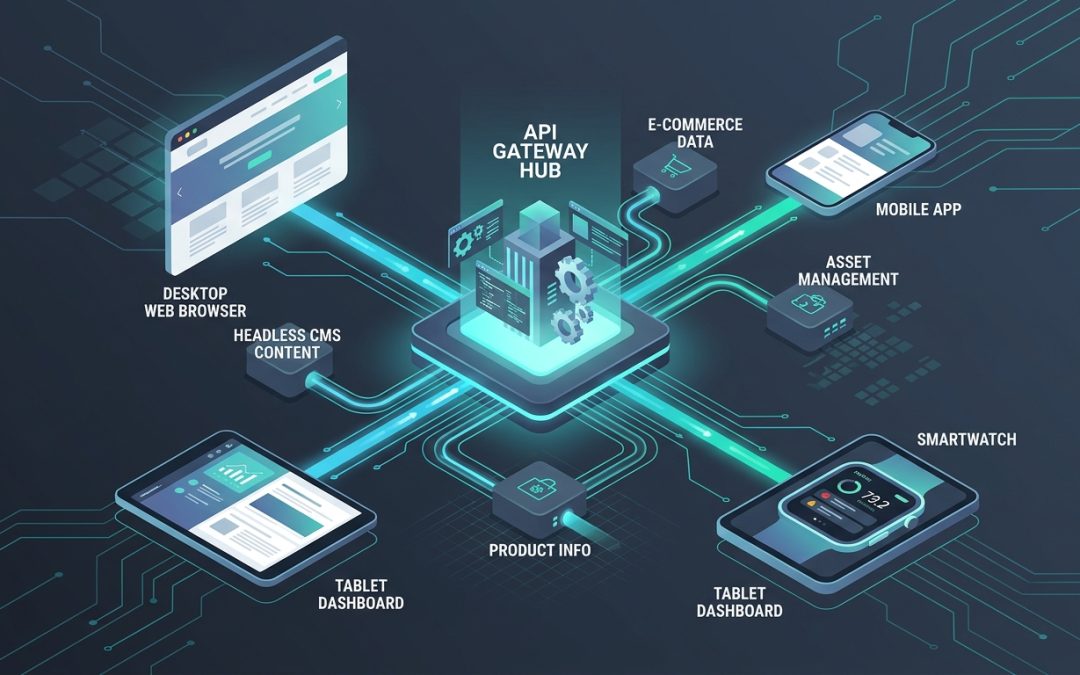
The 4 Core Layers of Composable Web Architecture: connecting structured headless content, unified API orchestration gateways, edge compute runtimes, and multi-platform omnichannel delivery interfaces.
1. Headless Content & Data Layer (Structured Content Modeling)
In a traditional CMS, content is written into visual WYSIWYG text editors that mix copy with HTML formatting tags (such as font sizes, colors, and line breaks). This unstructured content is impossible to repurpose across other platforms without broken styling.
In a headless architecture, content is treated purely as structured data. Platforms such as Sanity.io, Strapi, Contentful, and Hygraph enforce strict schema definitions where content is stored as clean JSON objects consisting of typed fields: string titles, author entity references, localized text strings, and high-resolution media assets:
- Content Modeling Independence: Content creators author a product description or technical case study once. The structured JSON data is simultaneously ingested by the web application, the mobile app, and external aggregator feeds without manual re-entry.
- Granular Governance & Localization: Enterprise teams manage role-based access control (RBAC), multi-market localization workflows, and multi-region staging environments without risking backend server crashes.
2. API & Orchestration Gateway (GraphQL & REST Middleware)
The glue that binds a composable stack together is the API orchestration layer. Rather than having client-side browsers execute fifteen separate requests to disparate microservices, an API gateway consolidates backend data into a single unified endpoint.
Standardized according to World Wide Web Consortium (W3C) Web API Standards, this layer leverages GraphQL or high-efficiency REST endpoints to query exactly what is needed:
- Federated GraphQL Schemas: A single query can retrieve the product details from a headless CMS, real-time inventory from an ERP, live pricing from a commerce engine, and customer ratings from a review API.
- Zero Over-Fetching: Mobile clients on bandwidth-constrained cellular connections request only the specific attributes needed for the view, slashing data payload sizes by up to 75%.
3. Edge Compute & Serverless Runtime (Next.js, Remix, Astro)
The presentation layer of a composable web platform is powered by modern JavaScript/TypeScript meta-frameworks deployed across globally distributed edge networks (such as Vercel, Cloudflare Workers, and AWS CloudFront). This layer eliminates the traditional trade-off between static page speed and dynamic functionality:
- Incremental Static Regeneration (ISR): Next.js allows thousands of product or editorial pages to be statically generated at build time, serving them instantly from CDN edge nodes. When an editor updates content in the CMS, a webhook triggers revalidation in the background, updating the edge cache in milliseconds without rebuilding the entire domain.
- Edge Middleware Personalization: Execute geolocation routing, A/B testing splits, and authentication checks directly at the edge server closest to the user (sub-10ms latency) before HTML ever reaches the browser.
4. Omnichannel Delivery Layer (High-Fidelity Presentation)
At the apex of the architecture sits the consumer-facing interface. Because frontend engineers are unencumbered by monolithic templating engines, they have complete design autonomy to engineer bespoke visual experiences:
- Flawless Component Design Systems: Build reusable, accessible UI component libraries utilizing Tailwind CSS, Radix UI, and React, guaranteeing design uniformity across the brand's entire global web footprint.
- Native Cross-Platform Sync: The identical API endpoints powering the desktop web application can instantly feed a React Native mobile app, an Apple Watch companion app, or an automated email newsletter sequence.
Quantifiable Business Impact: Speed, SEO, and Security ROI
Transitioning from a legacy monolithic system to a composable headless stack is a strategic investment that produces measurable enterprise financial returns across three critical operational pillars:
1. Dominating Google Core Web Vitals and Organic Rankings
Website performance is no longer merely a user experience preference; it is an official ranking factor governed by Google's search algorithms. As documented in technical guidance published by Google Search Central on Core Web Vitals, search engines prioritize web platforms that deliver instant visual stability and immediate interactivity.
Monolithic platforms struggle with Core Web Vitals because they force browsers to download heavy theme stylesheets, render-blocking JavaScript files, and redundant plugin scripts. In contrast, a custom-engineered headless Next.js frontend achieves near-perfect Lighthouse scores:
- Largest Contentful Paint (LCP): Under 1.0 second globally by serving pre-rendered HTML and optimized next-gen WebP/AVIF images directly from edge caches.
- Interaction to Next Paint (INP): Sub-50ms responsiveness by stripping unnecessary third-party scripts and code-splitting JavaScript so only critical route bundles are loaded.
- Cumulative Layout Shift (CLS): A score of 0.00 through strict aspect ratio reservations on media containers and layout grid discipline.
2. Radical Reduction of Enterprise Cyber Attack Surfaces
According to annual cybersecurity telemetry reports, over 90% of web CMS security breaches occur through vulnerable third-party plugins and insecure administrative endpoints on monolithic systems like WordPress and Joomla. Because monolithic platforms host the database, admin panel, and visual presentation on the same web server, a single vulnerability in an obsolete plugin can compromise the entire corporate database.
A headless architecture inherently provides enterprise-grade zero-trust isolation:
- Invisible Database & Admin Endpoints: The headless CMS operates on a completely separate, private network behind secure API tokens. The public-facing website is composed entirely of compiled static assets hosted across CDN edge nodes.
- Zero SQL Injection Vulnerability: Because the frontend does not directly communicate with SQL databases, malicious actors have no backend database query surface to exploit.
3. Accelerated Developer Velocity and Reduced Total Cost of Ownership (TCO)
On a monolithic platform, marketing campaigns are routinely stalled because simple layout adjustments require complex PHP theme modifications, risk regressions across other pages, and demand extensive staging tests. Headless architecture decouples these operational cadences:
- Autonomous Content Publishing: Marketers utilize structured visual block editors (such as Sanity Studio or Contentful Compose) to publish landing pages instantly using pre-approved, brand-compliant UI design components.
- Parallel Engineering Cycles: Frontend engineers can deploy micro-interactions and performance upgrades without waiting for backend database migrations, cutting feature release cycles from weeks to hours.
Enterprise Decision Matrix: When Should You Go Headless?
While composable web architecture provides unparalleled power, it requires disciplined architectural planning. Review this strategic decision matrix to determine the optimal timing for your organization:
|
Enterprise Profile |
Recommended Architecture |
Strategic Rationale & Commercial Impact |
|
Global B2B SaaS & Tech Scaleups |
Composable Headless (Next.js + Sanity / Strapi) |
Requires sub-second load times globally, dynamic interactive calculators, documentation portals, and rapid landing page creation for performance marketing. |
|
High-Volume Omnichannel E-Commerce |
Headless Commerce (Shopify Storefront API + Next.js) |
Eliminates sluggish Liquid theme bottlenecks; achieves instant product filtering, custom 1-click checkout funnels, and unified catalog syncing to mobile apps. |
|
Multi-Brand / Multi-Regional Corporate Entities |
Composable MACH Stack with Content Federation |
Allows centralized content governance across dozens of regional domain locales while enabling localized marketing teams to manage country-specific catalogs. |
|
Regulated Financial, Legal & Healthcare Services |
Decoupled Jamstack with Static Edge Pre-Rendering |
Eliminates public database attack vectors; ensures SOC2 and HIPAA compliance adherence; guarantees 99.999% uptime during high-concurrency traffic events. |
|
Early-Stage Local Brick-and-Mortar Business |
Traditional Lightweight Monolithic CMS (or Managed Builder) |
When a business requires only 5 static pages and has zero technical staff or developer support, a well-optimized monolithic CMS remains cost-effective. |
5-Step Roadmap: Migrating from Monolithic to Composable Without Downtime
Transitioning an enterprise web presence to a composable architecture does not require a risky, "big bang" cutover. Top engineering teams employ the Strangler Fig Pattern to incrementally modernize systems without risking search rankings or user disruption:
- Audit and Content Inventory: Catalog all existing database content types, taxonomies, and digital assets. Cleanse obsolete legacy fields and map unstructured HTML blobs into clean, typed JSON schemas.
- Model the Headless Content Repository: Establish your structured content model inside a modern headless CMS (such as Sanity or Strapi). Configure editorial permissions, validation rules, and automated asset processing pipelines.
- Engineer the Frontend Design System: Develop a high-performance Next.js or Astro presentation layer utilizing Tailwind CSS and modular React components. Ensure strict TypeScript types mirror the CMS API schema.
- Deploy Edge Reverse Proxy Routing: Implement edge routing (via Cloudflare or AWS CloudFront) in front of your domain. Route high-priority traffic sections (such as the blog, landing pages, or product catalog) to the new headless frontend while routing legacy paths to the existing CMS.
- Decommission Legacy Monolith: As routes are systematically migrated, decommission legacy monolithic plugins and servers. Transition your primary domain entirely to the global edge network.
Why Partner with Nrootz for Composable Web Engineering
At Nrootz, we reject slow, generic website templates and bloated page-builder plugins. We engineer bespoke, composable web architectures engineered for extreme speed, enterprise security, and compounding organic search dominance.
Our engineering team specializes in architecting custom Next.js web applications, headless CMS implementations (Sanity, Strapi, Contentful), headless e-commerce storefronts, and edge API orchestrations. We partner with ambitious software scaleups, forward-thinking B2B enterprises, and modern consumer brands globally to build bespoke digital platforms that deliver flawless user experiences and dominate search results. Whether you are re-architecting an enterprise platform or building a greenfield digital product, Nrootz provides the end-to-end technical mastery to turn your website into a high-performance commercial engine.
Frequently Asked Questions (FAQ)
What exactly is the difference between a headless CMS and a traditional CMS?
A traditional CMS (such as WordPress or Drupal) is a monolithic system that bundles the content database, editorial backend, and visual frontend presentation layer into a single application. A headless CMS completely removes the frontend presentation layer (the "head") and focuses solely on structured content creation and storage, exposing all data via REST or GraphQL APIs. This allows engineers to build ultra-fast, bespoke frontends using modern frameworks like Next.js that consume content across any digital device or channel.
Is a headless composable website more expensive to build and maintain than WordPress?
While the initial engineering investment for a bespoke headless architecture is higher than purchasing an off-the-shelf WordPress theme, the ongoing total cost of ownership (TCO) for scaling enterprises is significantly lower. Headless platforms eliminate expensive server hosting clusters, remove constant third-party plugin license fees, prevent catastrophic security breaches, and allow marketing teams to launch pages in minutes rather than waiting weeks for developer intervention.
Can non-technical marketing teams still preview and edit pages easily in a headless CMS?
Yes. Modern enterprise headless platforms (such as Sanity.io with Visual Editing or Contentful Studio) provide intuitive, real-time visual preview environments. Editors can click on elements in a live side-by-side preview to edit text, reorder visual content blocks, and schedule campaign updates across time zones without writing a single line of code.
How does composable headless architecture improve SEO and Google search rankings?
Composable architecture boosts SEO in three vital ways: First, pre-rendered static HTML and edge delivery achieve sub-second page load times and perfect Core Web Vitals scores, directly rewarding search rankings. Second, static HTML eliminates client-side JavaScript rendering delays, allowing search crawlers and AI search engines to index 100% of your content instantly. Third, clean semantic markup without monolithic plugin bloat makes structured JSON-LD schema integration effortless.
Can we migrate an existing enterprise website to headless architecture without losing traffic or ranking?
Yes, by utilizing the Strangler Fig migration pattern. By placing an edge reverse proxy (such as Cloudflare or Vercel) in front of your domain, you can migrate high-priority sections of your website (such as high-converting landing pages, blog hubs, or product catalogs) incrementally to the headless stack while keeping the legacy system running in the background. This ensures zero downtime, preserves exact URL structures, and protects hard-earned organic search rankings throughout the transition.