Introduction: The High Cost of the "Leaky Bucket" Ad Campaign
Every month, Indian B2B companies, healthcare institutions, real estate developers, and premium professional service firms invest lakhs of rupees into Google Search Ads, Meta Ads, and LinkedIn campaigns. Business leaders obsess over Cost-Per-Click (CPC), Quality Score, and click-through rates (CTR). Yet, when they examine their bottom line, they discover an alarming reality: over 95% of paid traffic bounces without generating a lead, booking a call, or making an inquiry.
The problem is rarely the ad campaign itself. The culprit is almost always a poorly architected, generic landing page. Most businesses commit the fatal error of directing high-intent, paid ad clicks to their bloated corporate homepage, or to an uninspired generic WordPress template crammed with navigation links, stock photos, and intimidating 10-field contact forms.
In modern performance marketing, driving traffic is only half the battle. If your landing page converts at 2%, doubling your ad budget merely doubles your customer acquisition costs. But if you elevate your landing page conversion rate from 2% to 6% through systematic Conversion Rate Optimization (CRO), you triple your qualified sales pipeline without spending a single extra rupee on ads.
As Kerala's premier custom web development and digital marketing consultancy, Nrootz specializes in engineering ultra-fast, high-converting digital landing pages tailored specifically for the nuances of the Indian commercial landscape. In this comprehensive blueprint, we deconstruct the exact behavioral psychology, visual architecture, and technical frameworks required to build landing pages that dominate paid search and maximize commercial ROI.
Core Search & CRO Rule: Informative blog text alone cannot solve search discoverability or user conversion. High-performance pages must integrate structured data tables, responsive visual assets, localized trust badges, and friction-free micro-interactions.
The Cognitive Psychology of Conversion: Attention Ratios & The F-Pattern
High-converting landing pages are not designed based on personal aesthetics or artistic whims; they are engineered around human visual cognitive processing. When a decision-maker clicks on an ad, you have approximately 3 to 5 seconds to capture their attention before they hit the browser "Back" button.
Pioneering usability research by the Nielsen Norman Group (NN/g) on F-Shaped Scanning Patterns proves that web users rarely read every word on a commercial page. Instead, their eyes scan horizontally across the upper boundary (headline and sub-headline), drop down along the left margin to read bullet points, and fixate on visually prominent contrast points (buttons, badges, and comparison tables).
Furthermore, high-converting pages operate on the principle of a 1:1 Attention Ratio. While a standard corporate website features 30 to 50 clickable links (header menus, dropdowns, footer links, social icons), a dedicated landing page eliminates all navigation escape hatches. There is exactly one single desired user action: submit the inquiry form or initiate an authenticated WhatsApp conversation.
Standard Low-Converting vs. High-Converting Landing Page Architecture
Examine how standard templates compare against a conversion-engineered landing page built for the Indian market:
| Design Dimension | Standard Low-Converting Template (1%–2%) | CRO-Engineered Landing Page (6%–14%) |
| Header Navigation | Full menu bar with 15+ external links and dropdowns | Zero navigation leaks (Logo + Single Click-to-Call/CTA) |
| Hero Headline | Vague corporate jargon ("Empowering Digital Synergy") | Crystal-clear Unique Value Proposition + Quantified Outcome |
| Lead Capture Mechanism | Exhaustive 8-to-12 field form requesting unnecessary data | Smart multi-step micro-form or instant 1-tap WhatsApp chat |
| Social Proof & Trust | Generic anonymous text quotes ("Great service! - John D.") | GSTIN verified badges, named client logos, verified case studies |
| Mobile Speed (India) | 5–8 seconds load time bloated with uncompressed scripts | Sub-1.5s load on 4G networks, 95+ Google PageSpeed score |
| Call-to-Action (CTA) | Low-urgency "Submit" or "Send Message" buttons | Action-oriented value copy ("Claim Free Growth Audit") |
Anatomy of a High-Converting B2B Landing Page: The 6 Non-Negotiable Sections
A winning landing page follows a battle-tested anatomical hierarchy that guides the prospect seamlessly from curiosity to commitment:
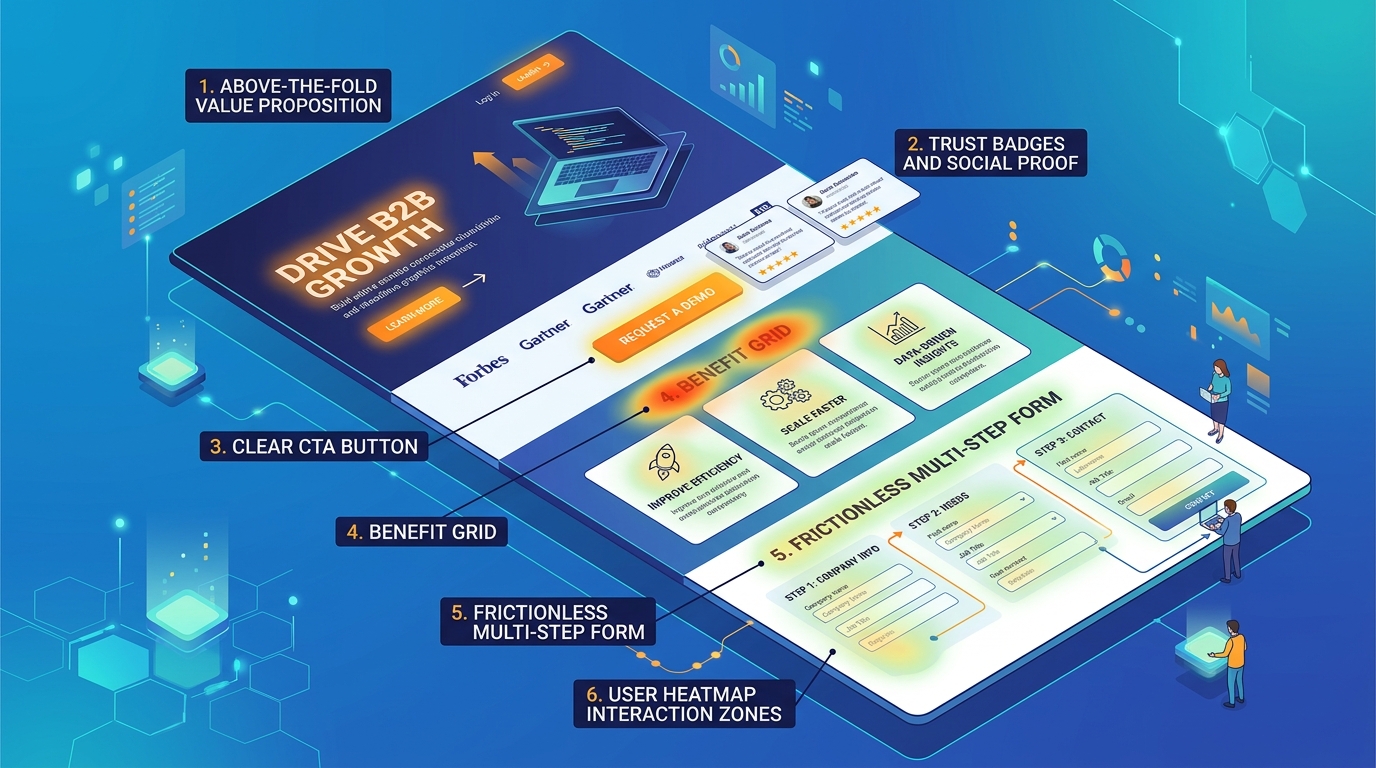
The 6 core structural components of a conversion-optimized B2B landing page wireframe, designed to maximize user engagement and minimize friction.
1. Above-the-Fold (ATF) Value Proposition
The screen space visible before scrolling is the most valuable real estate on the web. Your ATF section must answer three questions instantly:
- What is it? A bold, benefit-driven H1 headline (e.g., "Scale Your B2B Sales in India with High-ROI Google Ads Management").
- Why should I care? A supporting sub-headline addressing specific commercial pain points, timelines, and measurable results.
- What do I do next? A high-contrast CTA button paired with a micro-copy reassurance (e.g., "No credit card required. 100% Free 30-Min Strategy Call").
2. Regional Indian Trust Signals & Compliance Badges
Trust is the primary currency of digital transactions in India. Due to pervasive spam and fly-by-night operators, Indian decision-makers look for explicit safety signals before handing over their phone number or corporate email:
- Verified Business Credentials: Display official GSTIN registration numbers, ISO certifications, and MSME/Startup India badges.
- Recognized Client Logos: Showcase logos of established enterprises and respected regional brands from Kerala, Karnataka, and Tamil Nadu.
- Security Reassurances: SSL 256-bit encryption seals, Razorpay/Cashfree payment badges, and explicit NDAs.
3. The Benefit-First Value Stack
Amateur landing pages list product specifications; conversion-focused pages highlight emotional and commercial transformations. Organize benefits into structured grids:
- Feature: "Automated CRM Integration" → Commercial Benefit: "Never lose an inbound lead; your sales team is notified on WhatsApp in under 10 seconds."
- Feature: "Custom CSS Architecture" → Commercial Benefit: "Pages load in 1.1 seconds, eliminating 40% bounce rates on mobile."
- Feature: "Weekly Analytics Reporting" → Commercial Benefit: "Total visibility into your Cost-Per-Acquisition and revenue ROI."
4. Frictionless Multi-Step Lead Capture
Presenting a prospect with an 8-field form on initial view triggers cognitive fatigue and high abandonment. Multi-step forms leverage the "Foot-in-the-Door" psychological technique:
- Step 1 (Zero Threat): Ask low-friction qualifying questions (e.g., "What is your primary growth goal?" with clickable icon options).
- Step 2 (Engagement): Select business size or monthly budget tier.
- Step 3 (Completion): Request contact details (Name, Work Email, WhatsApp Number) to deliver the customized report or quotation.
Data from leading conversion platforms shows that multi-step forms increase overall completion rates by up to 86% compared to single-step forms asking for the exact same information.
5. One-Tap WhatsApp Business Integration
In India, WhatsApp is not merely a personal messaging app—it is the central commercial operating system. Incorporating an authenticated Click-to-WhatsApp button alongside traditional form submission provides prospects with an instant channel to speak directly with an expert, routinely increasing mobile conversion rates by 25% to 45%.
6. Authentic Social Proof & Verifiable Case Results
Generic text reviews can be easily fabricated. Authentic, high-impact social proof—featuring named client case studies, verified ROI metrics (such as a documented "+180% inbound lead surge in 60 days"), and recognized brand endorsements—provides undeniable proof that dismantles prospect skepticism and accelerates purchasing decisions.
Mobile Speed & Core Web Vitals: The Invisible Conversion Killer
Over 78% of ad traffic in India originates on mobile smartphones operating on 4G and 5G connections. If your landing page takes more than 3 seconds to load, you are burning your marketing budget before the user even sees your headline.
Comprehensive industry benchmarks compiled by Think with Google on Mobile Page Speed reveal that as page load time increases from 1 second to 3 seconds, the probability of a bounce increases by 32%. At 5 seconds, bounce probability surges by 90%.
Achieving sub-1.5 second load times requires ruthless performance engineering:
- Convert heavy PNG and JPG graphics to modern next-gen WebP and AVIF formats.
- Eliminate bloated drag-and-drop page builder plugins (Elementor, Divi, WPBakery) in favor of lightweight, custom-coded HTML5 and optimized CSS.
- Implement critical CSS inlining and defer all non-essential third-party JavaScript trackers (Meta Pixel, Google Tag Manager, Hotjar).
- Maintain an Interaction to Next Paint (INP) under 200 milliseconds to guarantee immediate responsiveness when buttons are tapped.
Industry Landing Page Conversion Rate Benchmarks in India
How does your current landing page perform against industry standards? According to the Unbounce Conversion Benchmark Report and Nrootz's internal campaign metrics, here is what top-performing Indian landing pages achieve:
| Industry Sector | Average Template Conversion Rate | Top 10% CRO-Engineered Rate | Primary Conversion Driver |
| B2B SaaS & Tech Solutions | 2.1% | 8.4% – 12.2% | Interactive product tour, ROI calculator, transparent pricing |
| Real Estate & Property Development | 1.8% | 6.5% – 9.8% | Instant brochure download via WhatsApp, interactive floorplans |
| Healthcare & Specialized Clinics | 3.4% | 11.0% – 16.5% | Doctor credentialing, verified patient outcomes, 1-tap call booking |
| Higher Education & EdTech | 2.8% | 9.2% – 14.0% | Placement record statistics, alumni salary data, syllabus download |
| Professional & Financial Services | 2.3% | 7.8% – 10.9% | Case study breakdown, compliance assurance, calendar scheduling |
The Continuous CRO Testing Protocol: How to Scale Revenue
Launching your landing page is only step one. True CRO is an iterative scientific cycle of continuous experimentation:
- Quantitative Analytics: Track precise drop-off points using event-level tracking in Google Analytics 4 and custom conversion pixels.
- Qualitative Heatmapping: Deploy heatmaps and session recordings to observe where Indian users hesitate, scroll, or experience "dead clicks".
- Hypothesis Generation: Formulate evidence-based test hypotheses (e.g., "Changing the primary CTA from 'Submit' to 'Get My Free Custom Strategy' will increase form completion by 20%").
- Controlled A/B Split Testing: Route 50% of incoming ad traffic to Version A (control) and 50% to Version B (variant). Run the test until achieving a 95% statistical confidence level before deploying the winning variant as the new baseline.
Why Custom Landing Pages Outperform Generic Templates
Many businesses assume that buying a $50 marketplace WordPress theme or using a drag-and-drop page builder is sufficient. However, generic templates are engineered to serve everyone—meaning they are optimized for no one. They carry massive CSS bloat, redundant JavaScript libraries, rigid layout constraints, and poor Core Web Vitals scores that drag down your Google Ads Quality Score and increase your Cost-Per-Click.
At Nrootz, our custom landing page engineering team handcrafts lightweight, mobile-first landing pages from the ground up. Every typography choice, button color contrast, micro-copy string, and responsive breakpoint is intentionally calibrated to maximize your conversion rate and squeeze every ounce of value from your marketing investment.
Frequently Asked Questions (FAQ)
What is the difference between a homepage and a dedicated landing page?
A homepage is a multi-purpose portal designed for comprehensive brand browsing, containing dozens of links, multiple menus, and diverse messaging. A landing page is a focused, standalone destination designed specifically for a single ad campaign or marketing initiative, with a 1:1 attention ratio and a single conversion objective.
Should I use a multi-step form or a single-step form for B2B lead generation?
For high-ticket B2B and professional services in India, multi-step forms almost universally outperform single-step forms. Breaking down the qualification process into 2 or 3 micro-steps lowers the perceived cognitive hurdle, qualifies prospect intent, and results in up to 86% higher completion rates.
How does landing page speed affect Google Ads performance and Cost-Per-Click?
Google Ads factors Landing Page Experience directly into your ad Quality Score (1 to 10). Pages with sub-2 second load times and high mobile usability earn superior Quality Scores, which directly lowers your actual Cost-Per-Click (CPC) by up to 50% while unlocking higher ad positions above competitors.
Why is WhatsApp integration essential on Indian landing pages?
WhatsApp is India's most ubiquitous and trusted communication platform. Offering a direct Click-to-WhatsApp option gives mobile visitors an instant, low-friction channel to ask immediate questions, bypassing email delays and telecalling resistance, which routinely lifts total mobile conversion volume by 25% to 45%.
How long should an A/B test run before declaring a winner?
An A/B test should never be concluded based on time alone. It must run until it reaches both a minimum sample size (typically at least 100 to 200 total conversions per variant) and a minimum 95% statistical significance to ensure that observed performance differences are genuine and not random noise.