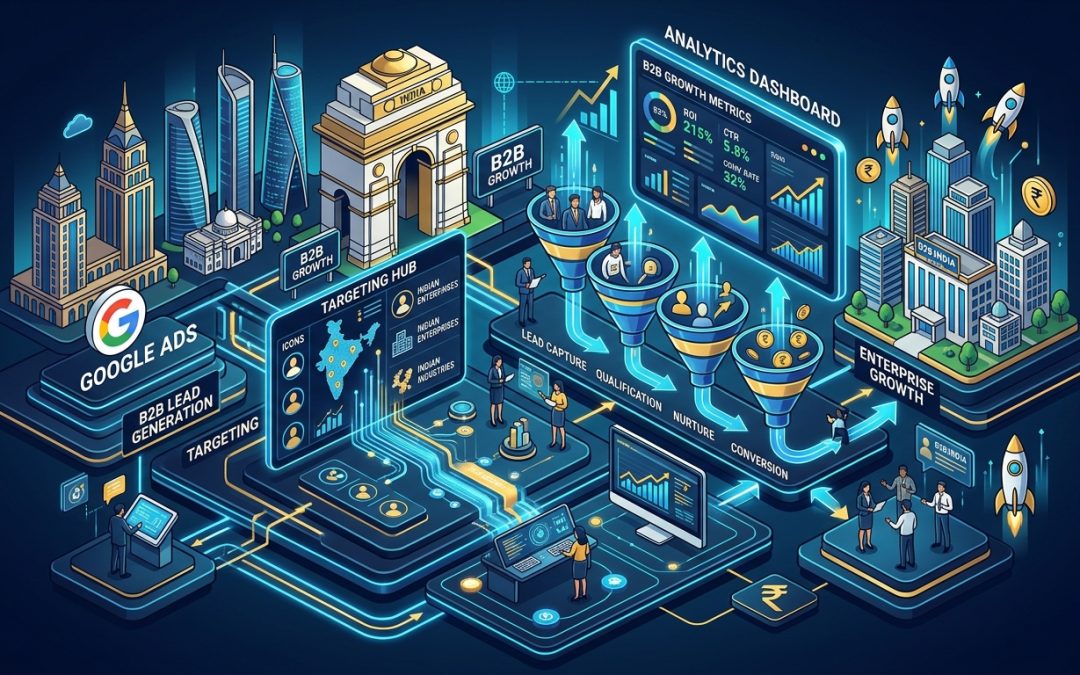
Introduction: The B2B Lead Generation Paradigm Shift in India
The Indian B2B landscape is undergoing a massive transformation. Gone are the days when enterprise sales cycles depended purely on cold calls, industry expos, trade directories, and informal networking channels. Today, corporate decision-makers—from C-suite executives in tech hubs like Bengaluru and Hyderabad to industrial procurement heads in Kochi, Mumbai, and Chennai—turn to Google when evaluating enterprise software, industrial machinery, contract manufacturing, corporate logistics, and specialized consulting services.
In this digital-first procurement era, capturing commercial intent at the exact moment of search is no longer an optional tactic; it is the cornerstone of sustainable pipeline velocity. While organic search engine optimization creates a formidable long-term foundation, Google Ads (Pay-Per-Click / PPC) provides the precision, immediacy, and scalability required to capture high-value enterprise leads on demand. However, running B2B Google Ads in India is fundamentally different from managing B2C retail campaigns. With elongated sales cycles, multiple corporate stakeholders, and substantial contract values, executing an amateur campaign can incinerate advertising budgets within days.
As a premier digital marketing and performance agency in Kerala, Nrootz has engineered this definitive guide to unpack how Indian B2B enterprises, SaaS companies, and industrial service providers can leverage Google Ads to generate consistent, sales-qualified leads (SQLs), minimize Customer Acquisition Cost (CAC), and achieve unprecedented Return on Ad Spend (ROAS).
Why Google Ads is the Ultimate Growth Engine for Indian B2B Enterprises
While social platforms like LinkedIn and Meta excel at generating brand awareness and account-based impressions, Google Search Ads captures unmatched active intent. When a procurement manager types "enterprise cloud ERP solution providers India" or "custom industrial automation contractors Kerala" into Google, they are not casually browsing a social media feed—they are actively seeking a vendor to resolve an urgent organizational requirement.
1. High-Intent Commercial Capture
Google Ads positions your enterprise directly in front of buyers at the evaluation and decision stages of the procurement funnel. By capturing searchers exhibiting specific problem-aware or solution-aware intent, your sales development representatives (SDRs) spend time nurturing prospects who already have budget, authority, and urgency.
2. Hyper-Targeted Geographic and Demographic Layering
India’s diverse commercial ecosystem requires granular geographic segmentation. A B2B enterprise manufacturing specialized rubber machinery in Kerala might want to target specific industrial clusters in Gujarat, Tamil Nadu, and Maharashtra, while excluding retail consumer queries. Google Ads allows granular radius targeting, state-level bidding adjustments, company demographic layering, and device exclusions to ensure your budget is deployed exclusively where your target decision-makers operate.
3. Full-Funnel Attribution and Predictable Revenue Modeling
Unlike traditional offline advertising where ROI calculation is largely speculative, Google Ads paired with advanced conversion tracking provides micro-level attribution. Every rupee spent can be tracked directly from search query, ad click, landing page submission, CRM qualification, to closed-won revenue.
B2B vs. B2C Google Ads: Key Strategic Distinctions
The most common reason Indian B2B businesses fail with Google Ads is treating enterprise campaigns like consumer e-commerce ads. Understanding the structural differences is vital for maximizing marketing ROI:
| Metric / Strategy | B2C Google Ads | B2B Enterprise Google Ads |
|---|---|---|
| Buying Cycle | Instantaneous to few days (impulse / emotional) | 30 days to 12+ months (committee-based evaluation) |
| Search Volume | High volume, broad search patterns | Low to moderate volume, ultra-niche technical queries |
| Cost-Per-Click (CPC) | Low to medium (₹10 - ₹80) | Moderate to high (₹100 - ₹1,500+) |
| Primary Conversion Goal | Direct sale / Add to cart / Instant checkout | Consultation booking, RFP download, custom quote request |
| Key Success Metric | Immediate Return on Ad Spend (ROAS) | Cost Per Qualified Lead (CPQL) & Customer Lifetime Value (LTV) |
The 6-Pillar Framework for B2B Google Ads Domination in India
Pillar 1: Precision Keyword Architecture & Intent Classification
In B2B lead generation, search volume is a vanity metric; search intent is the only reality. Targeting broad keywords like "logistics" or "accounting software" will flood your account with students, job seekers, and micro-merchants, rapidly exhausting your daily budget. Successful B2B campaigns categorize keywords into three distinct tiers:
- Tier 1: High Commercial Intent (Bottom-of-Funnel): Keywords containing commercial modifiers such as
"enterprise ERP vendors India","industrial cold storage contractors Kochi","hire custom software development agency India", or"B2B CRM software pricing". These represent ready-to-buy decision makers. - Tier 2: Competitor & Alternative Searches: Queries targeting incumbent enterprise competitors (e.g.,
"[Competitor Name] alternative India"or"[Competitor Name] enterprise pricing"). Prospects searching for alternatives are already educated and actively seeking a better vendor. - Tier 3: Problem & Solution-Specific Terms (Middle-of-Funnel): Searches addressing complex organizational bottlenecks, such as
"how to automate supply chain tracking for manufacturing plants". These searchers should be directed to high-value assets like whitepapers, case studies, or ROI calculators.
Pillar 2: Aggressive Negative Keyword Management
In the Indian market, negative keyword lists are the single most effective lever for preventing ad spend waste. Without exhaustive negative keyword lists, your ads will trigger for thousands of irrelevant consumer queries. An enterprise B2B negative list should systematically filter out:
- Employment & Career Queries:
jobs,vacancies,internship,salary,recruitment,resume,glassdoor. - Educational & Academic Searches:
course,free tutorial,syllabus,pdf download,project report,certification. - B2C & Low-Budget Qualifiers:
cheap,free,freeware,open source,DIY,second hand,used. - DIY and Retail Consumer Variants:
for home,single piece,retail store,amazon,flipkart.
Pillar 3: Compelling B2B Ad Copy & Enterprise Positioning
Your ad copy must act as a double-edged sword: it must attract high-value corporate decision-makers while actively repelling low-budget consumer clicks. To accomplish this, embed enterprise qualifiers directly within your Responsive Search Ads (RSAs):
- Incorporate Pricing & Minimum Thresholds: Explicitly stating "Enterprise Solutions from ₹1,00,000/mo" or "Minimum Order Quantity: 500 Units" deters unqualified clicks and saves valuable ad spend.
- Highlight Trust Badges and Social Proof: Utilize headlines featuring metrics, ISO certifications, client logos, and geographic authority (e.g., "Trusted by 200+ Indian Enterprises" or "ISO 9001:2015 Certified Manufacturer").
- Maximized Ad Assets (Extensions): Deploy every available asset including Sitelink Assets (linking to Case Studies, Pricing, Tech Specs), Callout Assets ("24/7 SLA Support", "Dedicated Account Manager"), Structured Snippets, and Lead Form Assets for instant mobile capture.
Pillar 4: High-Conversion B2B Landing Page Architecture
Driving high-intent clicks to your website is only half the battle. If your landing page is generic, sluggish, or cluttered, your conversion rate will crater. At Nrootz, we architect specialized B2B landing pages designed specifically to satisfy enterprise procurement officers:
- Sub-2-Second Load Times: Enterprise decision-makers abandon slow pages. Clean code, Next.js or optimized WordPress architecture, and fast server response times are mandatory.
- Above-the-Fold Value Proposition: State clearly within 5 seconds who you are, what enterprise problem you solve, and what concrete outcome the client can expect.
- Friction-Optimized Form Design: Balance qualification with conversion. Asking for too much information (e.g., 15 fields) reduces conversion rates, but asking only for an email yields unqualified leads. The sweet spot for Indian B2B: Work Email, Full Name, Phone Number, Company Name, and Approximate Budget/Requirement Dropdown.
- Prominent Trust Signals: Display client logos, verified client video testimonials, security badges (SOC2, GDPR, ISO), and verified Google review ratings.
Pillar 5: CRM Integration & Offline Conversion Imports (OCI)
The standard Google Ads pixel tracks form submissions on your landing page. However, not every form submission is a paying client. A campaign generating 100 leads at ₹500 each might look fantastic on Google Ads, but if zero leads turn into revenue, the campaign is a complete failure.
To overcome this, modern B2B campaigns must implement Google Ads Offline Conversion Tracking (OCT). By passing the unique Google Click Identifier (GCLID) from your web forms into your CRM (such as HubSpot, Salesforce, Zoho CRM, or LeadSquared), your marketing team can send milestone updates back into Google Ads when a lead progresses to:
- Marketing Qualified Lead (MQL)
- Sales Qualified Lead (SQL)
- Opportunity / Proposal Stage
- Closed-Won Deal (with actual invoice value)
This allows Google’s Smart Bidding AI (such as Value-Based Bidding and Target ROAS) to optimize your bidding strategy around actual paying enterprise contracts rather than cheap, low-intent form fills.
Pillar 6: Smart Bidding Strategy Evolution
New campaigns should never start on automated target ROAS or Target CPA without baseline conversion data. A structured bidding maturity model ensures budget efficiency:
- Phase 1 (Data Collection - Weeks 1-4): Utilize Maximize Clicks with a Maximum CPC Bid Limit or Enhanced Manual CPC to test keyword viability, build Quality Scores, and accumulate at least 30-50 high-quality conversion actions.
- Phase 2 (Conversion Optimization - Months 2-3): Transition to Maximize Conversions or Target CPA (Cost Per Acquisition) once the algorithm understands your primary audience profile.
- Phase 3 (Revenue Maximization - Months 4+): Leverage Maximize Conversion Value (Target ROAS) feeding offline revenue milestones from your CRM into Google Ads.
Top Mistakes Indian B2B Companies Make with Google Ads
Avoid these common pitfalls that drain marketing capital without generating qualified pipeline:
- Relying Exclusively on Broad Match Keywords: Broad match without extensive negative keywords and automated smart bidding will trigger unrelated consumer queries across India.
- Directing Traffic to the Generic Homepage: Sending paid search traffic to a homepage with multiple navigation links distracts visitors. Always send paid traffic to dedicated, distraction-free landing pages.
- Ignoring Remarketing and Demand Gen: B2B purchases involve lengthy consideration. Failing to retarget past visitors across the Google Display Network, YouTube, and Gmail with case study ads leaves money on the table.
- Measuring Quantity over Pipeline Quality: Celebrating low CPL (Cost Per Lead) when the sales team complains that leads are unqualified is a recipe for internal friction. Always align marketing metrics with sales pipeline velocity.
Conclusion: Accelerate Your Enterprise Pipeline with Nrootz
Generating high-ticket B2B leads through Google Ads is a sophisticated engineering discipline that blends keyword psychology, landing page UX, conversion rate optimization, and deep CRM attribution. In India’s hyper-competitive and rapidly expanding market, businesses that master paid search acquisition establish unshakeable market authority and predictable revenue growth.
At Nrootz, we specialize in architecting full-funnel digital marketing strategies, custom web design, and high-performance Google Ads campaigns tailored specifically for Indian and international enterprises. Whether you are looking to launch new enterprise lead generation campaigns or audit and optimize existing ad spend, our team delivers transparent, data-driven results that directly impact your bottom line.
Frequently Asked Questions
What is a realistic monthly budget for B2B Google Ads in India?
For most Indian B2B industries, an effective starting ad spend ranges between ₹40,000 to ₹1,50,000 per month, depending on keyword competition and target geography. This provides sufficient click volume (typically 200–500 targeted clicks) to test search queries, gather conversion data, and generate an initial flow of qualified sales leads.
How long does it take for a B2B Google Ads campaign to generate qualified leads?
Unlike organic SEO which requires 3 to 6 months to compound, Google Ads can generate clicks and initial form fills within 48 to 72 hours of launch. However, fine-tuning negative keywords, optimizing landing page conversion rates, and training Google’s bidding algorithm typically requires 30 to 60 days to achieve optimal Cost Per Qualified Lead (CPQL).
How can we prevent competitors and students from clicking our Google Ads?
While you cannot stop every competitor click, you can significantly mitigate invalid spend by using automated click fraud prevention tools (like ClickCease), implementing comprehensive negative keyword lists (filtering educational, career, and retail terms), excluding internal company IP addresses, and bidding on specific long-tail keywords that only serious corporate decision-makers search for.
Should B2B companies run Google Ads on their own brand name?
Yes. Running branded search campaigns is crucial for B2B enterprises. Branded keywords are extremely inexpensive, provide near 100% Quality Scores, prevent competitors from bidding on your brand name to steal high-intent traffic, and allow you to control the exact messaging and sitelinks displayed on the search engine results page.
Can small businesses benefit from AI search?
Yes. Small businesses with informative websites, strong local credibility, and helpful content can compete
effectively and gain visibility through AI-assisted search.